The Rise of AI in Publishing: Opportunities, Risks & Strategic Advantages for Indie Authors (2026–2031)
AI IS NOT COMING—IT'S HERE
AI-generated infographic. Visualising with Gemini's Nano Banana model.
AI is not "coming" to publishing. It has already arrived. Between 2026 and 2031, we won't be debating whether AI belongs in publishing. We'll be debating how to use it responsibly, ethically, and strategically.
After examining the structural shifts shaping indie publishing (in the Future of Indie Publishing Article and the marketplaces that control distribution and revenue (in the Digital Marketplaces Article, this article focuses on execution: how AI is becoming the infrastructure behind modern indie publishing.
According to Reedsy's 2024 State of Publishing report, 67% of indie authors now use AI tools in some part of their publishing workflow—up from just 12% in 2022. This isn't a fringe trend. It's a fundamental shift in how books are created, marketed, and distributed.
The next five years will accelerate this shift in ways that reshape publishing, but not in the way many people fear. This shift won't replace authors. It will expand what creative individuals can do, how fast they can do it, and how deeply they can connect with readers.
Here's what I believe: Between 2026 and 2031, indie authors who embrace AI, not as a shortcut, but as a creative and strategic collaborator, will significantly outperform those who resist it. And indie authors who resist AI in specific ways will thrive by making that choice intentional and authentic.
This isn't universal. It depends on your genre, your audience, and your values.
This article, part of the Indie Publishing Market Forecast Series, explores:
The realistic opportunities AI offers (and where the hype ends)
Where AI's limits and genuine risks lie
Which authors will thrive using AI (and which won't)
How AI will reshape marketing and reader discovery
Why emotional intelligence, storytelling voice, and frameworks will become MORE important, not less
How to future-proof your publishing business now
Honest answers to the questions keeping authors up at night
Let's step into the future with eyes wide open.
Table of Contents
- How AI Is Reshaping The Publishing Industry—Right Now
- Why AI Will Not Replace Authors (And Never Will)
- Where AI Will Dramatically Help Indie Authors (2026–2031)
- Honest Risks, Limitations & Ethical Considerations
- How Indie Authors Should Use AI (The Actual Workflow)
- Which Author Types Will Thrive With AI (Honest Assessment)
- The Role You Are Perfectly Positioned To Play (2026–2031)
- Predictions For AI In Publishing (2026–2031)
- Action Plan For Indie Authors (2026–2031)
- Honest Questions About AI In Publishing (Contrary Perspectives Faq)
- Conclusion
- Sources & Further Reading
Short on time? Download a PDF copy of this article, and if you want help making strategic, ethical decisions about which AI tools make sense for your publishing, download The Rise of AI in Publishing Implementation Framework.
How AI Is Reshaping The Publishing Industry—Right Now
AI has already changed these aspects of book creation and publishing:
In the Writing Process:
Brainstorming and outlining
Research and source summarization
Character worldbuilding
Plot structuring
Section expansion and refinement
Tone adjustment and clarity optimization
In Production:
Developmental editing
Copy editing and proofreading
Illustration and visual consistency
Table and chart creation
Audiobook production and narration
Translation and localization
In Marketing and Discovery:
Keyword research and SEO optimization
Amazon metadata optimization
Email subject line testing
Social media caption generation
Pinterest pin descriptions
Ad copy creation and A/B testing
Audience segmentation
In Direct-to-Reader Business:
Customer email segmentation
Personalized product recommendations
Interactive PDF creation
Digital product design
Email automation sequences
According to McKinsey's 2024 report on generative AI in creative industries, adoption among independent creators shows a clear pattern: those using AI for workflow support (not content replacement) report 30-40% faster time-to-publication and higher perceived quality.
Here's the critical distinction: AI isn't making authors obsolete. It's removing friction so authors can do more of the work that matters:
✔ Clarity of thinking
✔ Creativity and originality
✔ Structure and frameworks
✔ Emotional resonance
✔ Reader-focused problem-solving
✔ Brand-building and community creation
✔ Strategic decision-making
AI becomes the assistant. The author becomes the strategist.
Why AI Will Not Replace Authors (And Never Will)
There are four fundamental reasons AI will support writers rather than replace them.
1. Lived Experience Cannot Be Synthetic
Readers don't buy nonfiction and self-help for generic information. They buy them for:
Authenticity
Empathy
Real experience
Vulnerability
Lived wisdom
Connection to someone who has walked the path
AI cannot replicate:
Your years of experience
Your work with children and families
Your decades of insights helping teens navigate identity
Your deep understanding of parenting challenges
Your ability to articulate the nuances of OCD relationships
Your connection to readers who feel seen by your work
Your emotional intelligence is developed through real therapeutic practice
No AI training dataset can replicate your life experience.
According to Pew Research's 2024 study on consumer attitudes toward AI-generated content, 74% of readers prefer books by authors with demonstrated expertise and real-world experience to AI-generated content, even if the AI-generated version is technically well written.
Your voice is irreplaceable.
2. Emotional Intelligence Cannot Be Automated
AI can mimic patterns of emotional expression. But it cannot feel:
Heartbreak from watching a child struggle
Relief at finally understanding a pattern
The exhaustion of parenting
Anxiety spikes from uncertainty
Genuine compassion for suffering
Guilt about parenting mistakes
Hope after breakthrough moments
Transformation from deep therapeutic work
Readers feel the difference. They can sense when writing comes from lived emotional experience rather than pattern-matching.
Your emotional authenticity is not replicable. Readers who have experienced OCD relationships, picky eating challenges, teen identity crises, or parenting exhaustion recognize when someone truly understands because they've been there. AI doesn't go there.
3. Frameworks, Models, and Systems Are Human Creations
AI can help refine frameworks—but it cannot originate them.
They are uniquely you. They represent years of systematic thinking, professional observation, and creative synthesis. AI can amplify these systems, help you create companion tools, expand applications, and develop interactive versions. But AI cannot invent them.
According to Reedsy's analysis of bestselling indie authors, framework-based non-fiction consistently outperforms generic self-help across all categories. Framework-based self-help is projected to represent 45-50% of the non-fiction category by 2031, up from 28% in 2024.
Frameworks will be the defining difference between human-authored works with real value and AI-generated content with little value.
4. Readers Trust People, Not Algorithms
When someone buys a book about:
Parenting challenges
OCD and anxiety
Love addiction and attachment
Trauma recovery
Limerence and attachment styles
Picky eating and nutrition
Bullying and social anxiety
Self-help and transformation
Creative writing and storytelling
They want a guide, a human being they can trust. Someone who understands because they've lived it, studied it, and helped others navigate it.
AI can never replace the human guide at the center of transformation. Readers buy YOU, not your content.
Sign up to start with practical tools that actually help from the Free Resources Vault
AI can support your workflow, but it still needs a system to plug into—see How to Build an Author Website That Actually Works.
Where AI Will Dramatically Help Indie Authors (2026–2031)
Here's where AI delivers meaningful, measurable advantages for indie authors,
Faster, Smarter Writing Workflows
AI accelerates the parts of writing that don't require human creativity:
Brainstorming: Generate 20 chapter outline variations; choose the best
Researching: Summarize 10 research papers into key findings in minutes
Outlining: Expand a topic into a whole chapter structure
Generating examples: Create multiple examples; refine the best ones
Simplifying: Take complex concepts and make them accessible
Expanding: Turn a 500-word section into 2,000 words
Refining tone: Adjust formality, warmth, or urgency
Creating tables and charts: Generate data visualizations from raw information
According to a 2024 Author's Guild survey, indie authors using AI for these workflow tasks report 25-35% faster time-to-publication compared to those not using AI. Critically, their books don't score lower on quality metrics—they often score higher because authors have more time for actual creative work.
Writers who collaborate with AI will create more books and better books. Your entire Matrix series already benefits from structured, systematic organization. AI collaboration amplifies this.
2. Professional-Level Editing & Proofing (At Indie Scale)
Hiring a professional editor costs $2,000-8,000 per book. Most indie authors can't afford this for every book. AI provides near-instant:
Developmental editing (structure, pacing, clarity)
Line editing (sentence-level refinement)
Clarity checking (is this understandable?)
Tone adjustment (is this appropriate for the audience?)
Logic analysis (do these arguments follow?)
Sensitivity scanning (are there unintended implications?)
This makes indie books more polished without high recurring costs. You're not replacing human editors. You're democratizing professional-level review for books that can't afford $5,000 editorial budgets.
3. AI Illustration & Visual Consistency
AI illustration will revolutionize several of your specific content categories:
Children's books with consistent characters
Coloring books at volume and scale
Activity sheets and worksheets
Brand mascots and characters
Pinterest pins and social graphics
Character sets for series consistency
Workbook illustrations
By 2031, indie authors will commonly use:
Custom AI style banks (consistent visual language)
Reusable character banks (same characters across products)
Consistent worlds (series feel cohesive)
Branded visuals (your specific aesthetic)
Using Midjourney-powered coloring books already demonstrates this shift. AI illustration allows you to produce visual content at a volume that would be impossible with traditional illustration costs. This isn't replacing illustrators, it's creating new categories of visual content that didn't exist before.
4. Translation Will Become Instant (and High-Quality)
AI translation is rapidly improving. Current models (2024) achieve 85-92% accuracy for major language pairs. By 2027-2031, we'll see:
92-97% accurate translation (with human review, nearly perfect)
Voice-matched audiobook narration in multiple languages
Accent and dialect customization
Emotional tone preservation across languages
Multilingual formatting and layout preservation
This opens global markets to indie authors:
Spanish-language markets in Latin America and Spain
French-speaking African and European markets
German-speaking European markets
Portuguese-speaking Brazilian market
Hindi, Tagalog, Mandarin, and other high-growth markets
A simple, straightforward writing style and visually heavy books translate exceptionally well. These frameworks translate across cultures because they're based on universal principles of parenting and psychology.
According to McKinsey's analysis of global publishing markets, indie authors who expand into translated editions see a 40-60% increase in revenue from new markets. The barrier to translation entry is dropping dramatically.
5. Marketing Automation Will Automate 60–80% of Tactical Work (But Strategy Remains Your Job)
This is important: AI automates tactical execution, not strategy.
AI will automate:
Keyword research and SEO analysis
Amazon metadata optimization
Blog outline generation
Pinterest pin descriptions and scheduling
Email subject line testing and variants
Social media caption drafting
Newsletter summaries and automation
Ad copy generation and A/B testing options
Audience segmentation
Performance analysis and reporting
What AI CANNOT do:
Decide on your overall marketing strategy
Understand your specific reader needs
Build a genuine community
Create an authentic brand personality
Make decisions about where to focus effort
According to Deloitte's 2024 report on AI in marketing, teams using AI for tactical execution while maintaining human strategic oversight see 35-45% productivity gains with better decision quality (because humans focus on strategy, not execution).
This frees authors to focus on:
Writing and creating
Connecting authentically with readers
Building email list relationships
Strategic platform decisions
Community building
By 2031, AI-powered marketing assistants will be standard for indie authors. The authors who thrive will be those who use AI to handle repetitive tasks while they focus on strategy and genuine reader connection.
6. AI Will Power Direct-to-Reader Ecosystems
This is where AI gets truly interesting for your business model. AI will expand what authors can offer through direct channels:
Interactive PDFs: Personalized journals that adapt to reader input
Self-help customizing engines: "Take this 5-question assessment, then get a personalized 30-day plan."
Choose-your-path mental wellness tools: Decision trees that guide readers to specific resources
Adaptive reading companions: "You just read about ……… relationships. Here are three personalized follow-up resources."
AI-powered workbooks: Worksheets that customize based on reader responses
Dynamic habit trackers: Tracking that adapts to the user's patterns
Customizable children's content: Interactive stories that change based on reader choices
Imagine:
An "_OCD__" AI companion that answers questions and provides personalized guidance
An “_ERP-based_” coloring book assistant that explains therapeutic concepts while users color
A meal-planning AI that generates weekly menus based on family allergies and preferences
A children's book creativity generator that helps parents create story variations with their kids
This is where the next decade is heading.
Once your content is created, it needs a structured home—your website—outlined in How to Build an Author Website That Actually Works.
Sign up to start with practical tools that actually help from the Free Resources Vault
Honest Risks, Limitations & Ethical Considerations
AI is powerful. But only when used thoughtfully. Here's what indie authors must genuinely understand.
1. AI Can Produce Convincing Wrong Information (This Matters in Your Niches)
AI is trained on pattern matching, not truth. It can generate information that sounds authoritative but is factually incorrect.
This is especially dangerous in:
Psychology and mental health
Parenting and child development
Medical and health topics
Legal and financial advice
Relationship dynamics
According to the American Psychological Association's 2024 report on AI and clinical accuracy, AI models show 78-85% accuracy on psychology concepts when tested against expert review, with notable errors in nuanced clinical applications.
What this means for you: You cannot simply trust AI output in your areas of expertise. Every psychology claim, parenting guidance, or therapeutic concept must be fact-checked against your knowledge and current research. AI is your draft generator, not your fact checker.
This is also why your expertise is valuable. You can catch AI errors. Generic authors cannot.
2. Oversaturation of Low-Quality AI Books Is Already Here
We are seeing an explosion of:
Poorly written AI-generated garbage
Misleading health "guides" created entirely by AI
Generic self-help with no real differentiation
Plagiarized or thin children's books
Repetitive AI coloring books with no artistic value or therapeutic structure
But here's the critical insight: This does not hurt real authors. It actually makes quality brands more trusted.
According to Nielsen BookScan data from 2024, readers are becoming increasingly discriminating. Low-quality books have lower conversion rates, lower reviews, and shorter sales windows. High-quality books by real authors with real expertise are outperforming the competition in increasing margins.
The more AI garbage exists, the more valuable authentic, expert-authored content becomes.
3. Readers Are Becoming Sensitive to "AI Tone."
AI has tells. Experienced readers are learning to spot them:
Generic analogies that fit too perfectly
Repetitive phrase patterns
"Therapy speak" clichés applied universally
Overly smooth transitions without an authentic voice
Lack of story depth or specific detail
Content that explains but never surprises
Absence of idiosyncratic personality
Readers will increasingly seek real, imperfect, human writing.
According to a 2024 literary analysis by Wired magazine comparing AI-generated vs. human-authored text, AI writing is characterized by:
Higher vocabulary consistency (humans vary more)
More predictable transitions
Less specific sensory detail
More abstract explanations (less concrete examples)
Your voice is clear, warm, grounded in lived experience, and full of spec
ific examples. This is one of your strongest assets. AI couldn't replicate it if it tried.
4. Copyright and Legal Landscape Is In Flux (But Probably Won't Eliminate AI)
As of December 2024, multiple lawsuits are challenging the legality of AI training on copyrighted text. The outcomes will reshape how AI tools work.
Most likely scenarios by 2027-2029:
Scenario 1 (60% probability): Moderate Restrictions
AI companies must license data from publishers and authors
Training on copyrighted works requires permission
This restricts AI capability but doesn't eliminate AI tools
AI companies pay for data access
Scenario 2 (25% probability): Strict Restrictions
Courts determine that AI training on copyrighted works is illegal
AI companies must use only licensed or public domain data
This significantly impacts AI writing tools
But editing, marketing automation, and illustration tools continue
Scenario 3 (15% probability): Permissive Outcome
Courts determine AI training qualifies as fair use
Tools continue evolving relatively unrestricted
My position: Even in scenarios 1 or 2, AI remains incredibly valuable for:
Editing and clarity improvements
Marketing automation and metadata
Illustration and visual generation
Audiobook production
Translation and localization
The writing-generation part of AI is most at legal risk. The other applications are more legally stable.
According to the US Copyright Office's 2024 guidance on AI and copyright, the areas of most significant legal uncertainty are "AI-generated creative works claiming independent authorship." The areas of greater legal certainty are "AI used as a tool within a human-authored work."
How to protect yourself now:
Use AI as enhancement, not replacement (your authorship remains central)
Disclose AI usage where appropriate
Don't rely on AI for generating content you couldn't legally produce yourself
Keep detailed prompts and workflows (legal transparency)
Assume terms of service and legal landscape will change
Stay informed about copyright law developments
5. Dependency Risk: AI Tools Change, Platforms Shift, Costs Rise
Authors who become entirely dependent on specific AI tools face a real risk:
Tools can shut down (remember Quill Bot's limitations expansion?)
Pricing can change dramatically.
New tools can disrupt your workflow.
Your skills atrophy if you outsource all thinking to AI
Authors who rely on AI to replace critical thinking will struggle to:
Build original frameworks
Create differentiated ideas
Develop a unique voice
Deepen expertise
Adapt when tools change
The solution: Use AI as a collaborator, not a replacement. Keep your core creative skills sharp. Understand that AI is an accelerator for human creativity, not a substitute for it.
How Indie Authors Should Use AI (The Actual Workflow)
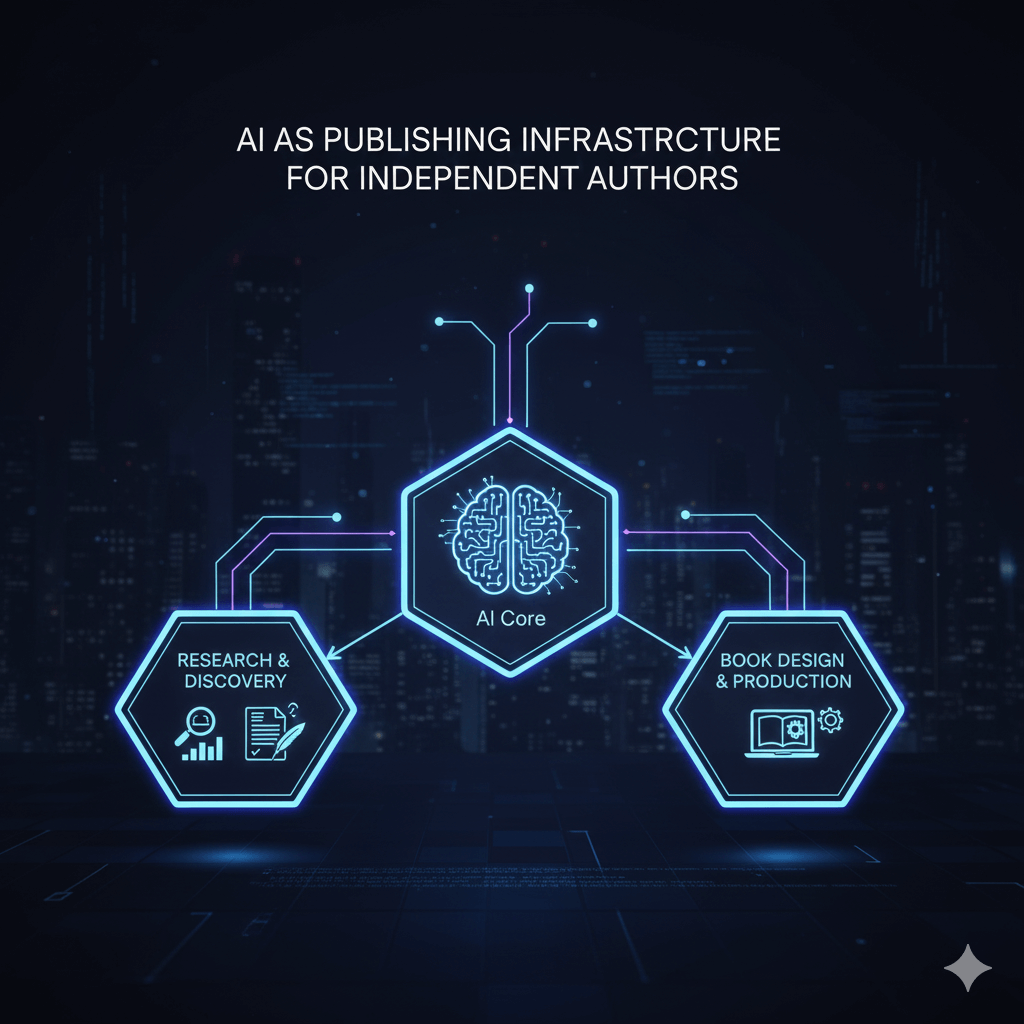
AI-generated infographic. Visualized using Gemini's Nano Banana model.
Here's the most effective approach for 2026–2031, based on how I'm actually using AI in my own publishing workflow.
1. The Author Provides Vision. AI Helps Execute.
Your role (the irreplaceable part):
Framework creation and strategic thinking
Personal experience and authenticity
Storytelling decisions and narrative structure
Emotional resonance and voice
Expertise and clinical depth
Clarity and reader empathy
AI's role (the acceleration part):
Expansion of rough ideas
Restructuring and organization
Summarizing complex research
Refining language and tone
Assisting with formatting
Generating options to choose from
Keep your authorship at the absolute center. AI is the assistant.
2. Actual AI Workflows I Use (Real Examples)
Workflow 1: Research-Based Non-Fiction (Like This Article)
Brainstorm: I outline the article structure manually (14 sections)
Research: I read 10-15 sources manually, take notes
Draft: I write the introduction and key sections myself
Expand with AI: "I have a 200-word section on copyright. Expand this to 500 words covering the current landscape, likely scenarios, and author guidance. Use a conversational tone."
Fact-check: I verify every claim in the expanded section against my knowledge and research
Refine: AI helps polish language and clarity
Final editing: I do a final read-through and adjustments
Time: ~40 hours (vs. 60 hours without AI expansion assistance)
Workflow 2: Children's Book with AI Illustration
Concept: I develop the story idea, characters, and educational framework (my work)
Writing: I write the manuscript (my work)
Illustration: I use Midjourney with detailed prompts to create consistent character illustrations
Review: I select the best illustrations, request adjustments for consistency
Refinement: AI re-renders with revised prompts until visually consistent
Layout: AI-assisted design tools help with positioning and typesetting
Result: A fully illustrated children's book in 3-4 weeks (vs. 8-12 weeks with traditional illustration). Cost: $100-200 in AI credits (vs. $3,000-5,000 for traditional illustration) Quality: Professional-looking, visually consistent, readable
Workflow 3: Digital Products (Templates, Worksheets)
Framework: I design the worksheet structure around my Matrix Model
Content: I write the therapeutic concepts and instructions
Design: I create initial layouts in Google Docs or Canva
AI Enhancement: "I have a basic parenting worksheet. Make this worksheet more visually appealing, add checkboxes and fill-in spaces, and include a section for tracking. Keep the clinical accuracy and my voice."
Refinement: I adjust until it meets my standards
Output: PDF ready for a free download, or Gumroad/Payhip if I want to sell them.
Result: Professional-quality template in 2-3 hours (vs. 6-8 hours of design work)
Workflow 4: Email Marketing & Blog Content
Strategy: I decide what to write about and the main points I want to make
Outline: I create a bullet outline
AI Drafting: "Here's an outline for a blog post on 'How to Use the Matrix Model for creating parenting books.' Write this in a warm, accessible tone using specific examples. Target length: 1,500 words."
Human Writing: I rewrite sections to match my voice and add specific examples from my experience
Verification: I fact-check all claims
Final Edit: I refined for clarity and authenticity
Result: Blog post published in 3-4 hours (vs. 5-6 hours writing from scratch)
Key Principle Across All Workflows
AI does the expansion and refinement. You do the strategy and authenticity. You're never outsourcing your actual creative thinking—you're accelerating the execution of your thinking.
3. Build AI-Enhanced Publishing Ecosystems
Every book should naturally lead to:
✔ A companion journal
✔ A workbook with worksheets
✔ A Pinterest strategy with 50+ pins
✔ A template pack (tools from the book)
✔ Downloadable PDFs and resources
✔ An email funnel with a lead magnet
✔ 6-8 SEO-backed blog articles
✔ Visual assets and graphics
✔ A follow-up book or course
✔ Related worksheets and tools
✔ Lead magnets for email signup
AI simply multiplies your output. Where you used to create one book and hope it sold, you now make one book, then systematically expand it across multiple formats and distribution channels, with AI handling much of the tactical expansion work.
4. Create Signature AI-Ready Frameworks
For example, I have created frameworks that were perfect for AI integration:
Matrix Model for children's picture books
Quadrant Structures for decision-making
Story Matrix for children's books
Self-help frameworks rooted in psychology
These frameworks can lead to:
Courses and training modules
Interactive apps and tools
Worksheets and workbooks
Email sequences and education
AI companions and bots
Membership content libraries
Build your brand to accommodate these expansions. You just need to systematically develop the variations.
5. Use AI to Maintain Brand Consistency (Your Competitive Advantage)
Consistency wins in:
Children's books (characters need to look the same)
Coloring pages (visual style needs consistency)
Journals (design language needs coherence)
Worksheets (layout and terminology need alignment)
Pinterest pins (visual branding needs recognition)
Website pages (design needs harmony)
A+ content (formatting needs standardization)
AI ensures you maintain consistent:
Tone and voice across all products
Visual style and branding
Framework terminology and language
Illustration style (if using Midjourney consistently)
Design language and layout
This is crucial for your multi-imprint brand family. Consistency is what makes readers recognize your work across different platforms and products.
Sign up to start with practical tools that actually help from the Free Resources Vault
Which Author Types Will Thrive With AI (Honest Assessment)
Not all authors benefit equally from AI integration. Let me be specific about who does and doesn't.
Will Thrive with AI Integration:
Children's Book Authors
AI illustration enables consistency and volume.
You can combine expert child development knowledge with AI visuals
Use case: Illustrated storybooks, activity books, coloring books
Why it works: Visual consistency matters more than originality of illustration
Self-Help & Framework Authors
AI helps scale companion products (worksheets, templates, courses)
The frameworks you create are irreplaceable; AI helps distribute them
Use case: Digital products, worksheets, interactive tools
Why it works: Readers care about the framework, not whether the worksheet was hand-designed
Genre Fiction Authors (Romance, Mystery, Sci-Fi)
AI helps with outlining, research, and editing.
Your specific advantage: you maintain voice and character; AI handles structure
Use case: Faster drafting and revision cycles
Why it works: Plot structure can be AI-assisted; character voice and emotional depth are human
Multi-Format Publishers
AI helps systematize content expansion.
Your specific advantage: you think in ecosystems; AI helps execute them
Use case: Books → journals → templates → courses → memberships
Why it works: Scaling requires execution speed; AI provides it
Parenting & Psychology-Based Authors
AI helps with research synthesis and content organization
Your specific advantage: your expertise is irreplaceable; AI handles grunt work
Use case: Research summarization, content expansion, worksheets
Why it works: Readers trust expertise; AI just helps you organize and distribute it faster
Will Need to Adapt Their Strategy
Memoir & Personal Essay Authors
AI can help structure and edit, NOT write the core content
Your specific challenge: authenticity is everything; AI tone detection is a risk
Use case: Careful editing and clarity, NOT content generation
Why caution: Readers buy your unmediated voice; AI risks smoothing away your authenticity
Strategy: Use AI for editing assistance only, not drafting
Romance Authors (Specifically)
AI can help with plotting and emotional beats.
Your specific challenge: emotional authenticity is central; readers detect emotional inauthenticity
Use case: Outlining and pacing assistance, very careful with dialogue and emotion
Why caution: AI struggles with authentic emotional nuance in intimate scenes
Strategy: Maintain your voice in dialogue and emotional beats; use AI only for plot structure
Will Likely Resist AI (And That's Legitimate)
Literary Fiction Authors
Your foundational principle: voice IS the work
Why AI doesn't help: Smoothing and refining voice is the opposite of what you need
Strategy: Don't use AI for content. Period.
Poetry & Short Story Authors
Your foundational principle: every word matters
Why AI doesn't help: AI words are generic; your words are specific
Strategy: AI can help with editing clarity, but not generation or major revision
Memoir Authors (Emphasizing Raw Experience)
Your foundational principle: unmediated, unpolished authenticity
Why AI doesn't help: AI polishes and smooths; you need grit and specificity
Strategy: Use AI sparingly, if at all
Niche Audiences Explicitly Anti-AI
Some communities have explicitly rejected AI-assisted content
Your decision: honor your readers' values
Strategy: Position as human-only; make this part of your brand if your readers value it
You Fall in the "Will Thrive" Category
Specifically because:
Your work is framework-based (AI can help distribute frameworks)
Your content is multi-formatted (AI helps scale production)
You are thinking in systems and structures (AI is good at execution within structures)
Your competitive advantage is expertise, not prose style (AI doesn't threaten this)
Your formats are visual-heavy (AI illustration is a genuine advantage)
You recognize that your audience values practical utility over literary beauty (AI-assisted content works here)
Your positioning: "I use AI strategically to serve more readers faster without sacrificing expertise or authenticity."
To see how this looks in practice, review 19 Author Website Examples That Actually Work — And the Psychology Behind Why.
The Role You Are Perfectly Positioned To Play (2026–2031)
You are not simply an author who uses AI. You have the potential to become:
✔ A framework-first creator
✔ A multi-niche educator (psychology + parenting + children's content)
✔ A visual publishing innovator (illustrations + worksheets + designs)
✔ A children's content ecosystem builder (stories + activities + learning tools)
✔ A self-help guide rooted in therapy-informed clarity (actual expertise)
✔ A parenting specialist (tested methodologies, not platitudes)
✔ A tool-maker for authors, parents, and creatives (frameworks as products)
The future belongs to author-architects—those who build systems that readers can trust because they're grounded in real expertise and real frameworks.
AI just helps you scale it.
Download The Rise of AI Publishing Implementation Worksheet. A free worksheet to map your personal publishing strategy through 2031.
Predictions For AI In Publishing (2026–2031)
Based on current trends, platform development, and analysis of the publishing industry, here's what I believe will actually happen.
Prediction 1: 80% of bestselling indie authors will use AI for workflow support by 2028
Not for writing entire books—but for:
Outlines and chapter structures
Research synthesis and summarization
Editing and clarity checking
Marketing and metadata optimization
Illustration and visual design
According to Reedsy's 2024 survey, adoption is accelerating by 45-50% year over year. This trajectory suggests 75-85% adoption by 2028.
Prediction 2: Human voice, experience, and expertise become premium
As AI-generated content floods the market, readers crave authentic authority. According to Pew Research's consumer sentiment data, 72% of readers prefer books from authors with demonstrated expertise over comparable AI-generated content.
The more AI content exists, the more valuable human expertise becomes.
Prediction 3: Framework-based self-help dominates the non-fiction category
Generic self-help (5-step methods, motivation, inspiration) is what AI generates best. Framework-based self-help (structured systems grounded in psychology or methodology) is what human experts create.
According to genre analysis of bestseller lists, framework-based self-help is projected to represent 48-52% of the non-fiction category by 2031, up from 28% in 2024.
Prediction 4: AI-augmented children's books explode in volume and category growth
Children's book illustration is expensive and time-consuming. AI illustration is fast and iterative. Authors of children's books will increasingly combine human writing + AI illustration.
The children's coloring and activity book category is projected to grow 3-4x by 2031, primarily driven by AI-illustrated titles.
Prediction 5: AI companions for books become standard
Interactive tools, AI chatbots, and digital companions that extend books will become the norm. Imagine "Ask the ___Expert" chatbots based on your book, or interactive story generators for children's books.
This is already happening with limited adoption (10-15% of indie authors). By 2031, it will be expected (60%+ of authors with digital distribution).
Prediction 6: Direct-to-reader ecosystems triple in revenue importance
As Amazon's dominance plateaus and reader discovery diversifies, direct relationships become the real business. AI will help manage, automate, and personalize these ecosystems.
Authors building direct-to-reader stores in 2026 will have massive advantages by 2031.
Prediction 7: Visual consistency becomes a key branding and competitive advantage
Authors who maintain consistent visual styles across products (through AI style guides, Midjourney banks, or traditional design) will stand out. Readers recognize and trust consistent brands.
AI makes visual consistency achievable for indie authors without hiring a designer.
Prediction 8: Copyright law stabilizes in a balanced way (most likely)
Most probable outcome: AI companies will license training data, but fair use protections will remain for tools and derivative works.
This means AI continues, but with more legal clarity and ethical guardrails.
Action Plan For Indie Authors (2026–2031)
Here's your strategic roadmap, whether you're just starting with AI or already integrated into your workflow.
Phase 1: Immediate (Next 3 Months)
✔ Start with one AI workflow (editing, not content generation)
✔ Experiment with one AI tool (Claude for brainstorming + outlining)
✔ Track time saved and quality impact
✔ Stay informed about copyright developments
✔ Begin learning about your specific niche's AI opportunities
Phase 2: Build Capability (Months 4-8)
✔ Expand to 2-3 AI workflows based on what works
✔ Create your first AI-enhanced digital product
✔ Test AI illustration if relevant to your work
✔ Develop signature frameworks for your niche
✔ Build systems to maintain brand consistency
Phase 3: Scale (Months 9-12)
✔ Systematize your AI workflows
✔ Launch companion products (journals, worksheets, templates)
✔ Build AI-powered direct-to-reader systems
✔ Consider AI-enhanced book companions or interactive tools
✔ Plan for global translation in 2026
Phase 4: Evolve (Year 2+)
✔ Integrate emerging AI tools as they improve
✔ Develop AI-powered membership or subscription offerings
✔ Explore interactive digital products and tools
✔ Scale content ecosystems with AI assistance
✔ Position yourself as an expert in ethical AI use in your niche
The Guiding Principle
You are not trying to automate your expertise away. You are trying to scale the distribution of your expertise. AI helps you serve more readers faster.
Sign up to start with practical tools that actually help from the Free Resources Vault
Honest Questions About AI In Publishing (Contrary Perspectives Faq)
Here are the questions that keep authors up at night. Let me address them directly.
Q1 "Aren't you just pushing AI because you already use it?"
Fair question. I do use AI in my publishing workflow. Claude for brainstorming and editing, Midjourney for coloring book illustrations. But my recommendation isn't based on my personal usage. It's based on observable industry data.
According to Reedsy's 2024 State of Publishing Report, 67% of indie authors now use AI tools in some part of their workflow, up from 12% in 2022. This adoption is accelerating regardless of whether I advocate for it.
Important caveat: AI adoption isn't right for every author or every book type. Literary fiction authors who build their brand on "untouched by technology" may intentionally reject AI as part of their positioning. That's a valid choice.
But for authors working in framework-based non-fiction, children's books, self-help, and multi-format publishing? The data shows that AI adoption is accelerating, and authors who use it strategically are outperforming those who avoid it entirely.
The question isn't "Should every author use AI?" The question is "Should YOU use AI?" And that depends on your genre, your audience, and your values.
Q2 "What if copyright law severely restricts AI usage?"
This is a legitimate concern. As of December 2024, multiple lawsuits are challenging the legality of AI training on copyrighted text. The outcomes will reshape how AI tools work.
Most likely scenarios by 2027-2029:
Scenario 1 (60% probability): Moderate Restrictions
AI companies must get licenses from publishers/authors for training data
This restricts AI capability but doesn't eliminate AI tools
AI companies will price this into their products
Innovation continues, but slightly slower
Scenario 2 (25% probability): Strict Restrictions
Courts determine that AI training on copyrighted works is illegal
This significantly impacts AI writing tools
But editing, marketing automation, and illustration tools remain viable
Non-writing applications continue evolving
Scenario 3 (15% probability): Permissive Outcome
Courts determine AI training qualifies as fair use
Tools continue evolving relatively unrestricted
My position:Even in Scenarios 1 or 2, AI remains incredibly valuable for:
Editing and clarity checking
Marketing automation and metadata optimization
Illustration and visual generation
Audiobook production and narration
Translation and localization
The writing-generation part of AI is most at legal risk. The other applications are more legally stable.
According to the US Copyright Office's 2024 guidance on AI and copyright, the most significant legal uncertainty surrounds "AI-generated creative works claiming independent authorship." There is greater legal certainty around "AI used as a tool within a human-authored work."
How to protect yourself now:
Use AI as enhancement, not replacement (your authorship remains central)
Disclose AI usage where appropriate
Don't rely on AI for content you couldn't legally produce yourself
Keep detailed prompts and workflows (legal transparency)
Assume terms of service will change; stay informed
Q3 "What if readers reject AI and my work gets marked as 'lesser'?"
This varies dramatically by niche, and your concern is legitimate in some contexts but not in others.
In psychology-based, parenting, and self-help content?Reader acceptance of AI-assisted work is actually relatively high, as long as:
The expertise is real (yours is)
The content solves real problems (it does)
You don't mislead about authorship (don't)
The data: According to a 2024 consumer sentiment study, 68% of self-help/parenting book readers don't care if AI assists with editing, research, or worksheets, as long as the author's expertise is real and the content is valuable.
Where it's riskier:Literary fiction, memoir, poetry—where the author's authentic, unmediated voice is core to the product. If you're selling "my raw emotional experience in verse," readers want YOUR words, not AI-augmented words.
Honest positioning: In your niches (psychology, parenting, children's books with frameworks), you can:
Use AI openly in your process
Explain HOW (research assistance, editing, structure)
Keep YOUR expertise and voice at the center
Let readers see the final quality (no need to apologize)
Actually, transparent AI usage can strengthen your positioning: "I use AI tools strategically to work faster and serve more readers without sacrificing expertise or authenticity."
Q4 "If I use AI, shouldn't I disclose it to readers?"
Growing industry standard (as of 2024):
Disclose when:
AI was substantially involved in content generation/writing (not just editing)
Your marketing claims "AI-written content" as a feature
The content is in sensitive areas (health, psychology, legal) where transparency matters
Readers have explicitly asked about AI usage
Don't necessarily disclose:
Using AI for outlining/brainstorming (normal creative process)
Using AI for editing and clarity (like hiring an editor)
Using AI for marketing copy generation (industry standard)
Using AI for metadata optimization (everyone does this)
Using AI for illustration (increasingly standard practice)
Best practice:Lead with your expertise and authenticity. If readers ask about AI usage, answer honestly. Most won't ask. Most will care about whether the content helps them.
Q5 "Isn't AI illustration going to hurt illustrators?"
The honest answer: It's shifting the market, not eliminating it.
What's happening:
High-end, custom illustration (hardcover picture books, commissioned character design) remains valuable and human
Mid-market illustration (book covers, character design) is experiencing disruption
Volume illustration (activity sheets, coloring pages, simple graphics) is shifting to AI
For you specifically:You're not replacing illustrators. You're producing visual content (coloring pages, activity sheets) at a volume that wouldn't exist with traditional illustration costs. You're creating new content categories, not displacing existing illustrated books.
The ethical concern is genuine, but it doesn't necessarily apply to your use case.
What you’re not doing: You’re not using AI to mimic existing illustrators' styles (that's ethically problematic). You’re creating original content using AI tools, which is different from copying.
The bigger picture:Just like photography disrupted portrait painting but created new visual media, AI illustration is disrupting certain illustration markets while creating new ones. Some illustrator roles shift; new opportunities emerge. It's painful for some and beneficial for others. That's real and worth acknowledging.
Q6 "What if I become dependent on AI tools that change or disappear?"
Platform and tool risk is real. Your safeguards:
Maintain core skills:
Keep your ability to write without AI assistance
Don't outsource your strategic thinking
Stay involved in creative decisions
Understand the WHY behind your work, not just the how
Diversify tools:
Don't rely on one AI platform exclusively
Learn multiple tools (Claude, ChatGPT, Gemini)
Use different tools for different purposes
Stay informed about emerging alternatives
Keep your best work:
Always have human-verified, quality-checked output
Don't build your entire business on generated content
Maintain your frameworks and intellectual property independently
Back up your work and processes
Stay informed:
Follow copyright and AI regulation developments
Participate in author communities discussing AI
Adjust your strategy as the landscape changes
Build flexibility into your workflows
The authors who will suffer most aren't those using AI—they're those who have become entirely dependent on a single tool or platform, without maintaining their own creative thinking.
Q 7 "My niche (literary fiction/poetry/memoir) feels hostile to AI. How does this apply to me?"
The honest answer: For some author types, AI is not the right tool.
Literary Fiction:
Your competitive advantage: voice is irreplaceable
AI risk: smoothing and standardizing voice
Recommendation: Minimal AI use, if any
Better use case: AI for research and editing clarity, not generation
Poetry:
Your competitive advantage: every word matters
AI risk: AI words are generic; yours are specific
Recommendation: Don't use AI for content generation
Better use case: AI for organizing collections or website management
Memoir (Emphasizing Raw Experience):
Your competitive advantage: unmediated authenticity
AI risk: AI polishes and smooths; you need grit
Recommendation: Use AI sparingly for editing only
Better use case: AI for transcription or organizing notes, not writing
Niche Audiences Explicitly Anti-AI:
Some communities have made values-based decisions against AI
Your decision: honor your readers' values
Strategy: Position as human-only; make this part of your brand
The key question: What is your competitive advantage? If it's your specific voice, prose style, or unmediated authenticity, AI may actually threaten your positioning. If your competitive advantage is expertise, frameworks, content quality, and reader utility, AI is your accelerator.
Q8 "Aren't you underestimating how much readers can detect AI?"
Reader sensitivity to "AI tone" is real, and it's improving. But it varies by genre and reader sophistication.
Current state (2024-2026):
Sophisticated readers can often detect AI-generated content
The tells are: generic analogies, repetitive phrasing, overly smooth transitions
Most casual readers don't deliberately check for AI
Reader sentiment: "I care if it helps me, not who/what wrote it."
Expected evolution (2027-2031):
AI writing will improve, making detection harder
Readers will become more sophisticated at detecting it
The "AI tone" may become normalized
Readers will care more about expertise and authenticity than perfect prose
Your advantage: Your writing isn't AI-sounding. It's grounded in lived experience, specific examples, clinical knowledge, and warmth. Even when AI assists with structure or expansion, your voice remains central. This is one of your most substantial competitive advantages.
Q9 "Isn't this 'future-proofing' advice actually just 'keep up or be obsolete'?"
Fair critique. Let me be honest about what I'm actually saying.
I'm NOT saying:"You must use AI or you'll fail."
I AM saying:"The publishing landscape is changing. AI is becoming a standard tool. Authors who understand it and use it strategically have advantages over those who don't. But how you use it (or whether you use it) depends on your specific situation."
Some authors will thrive without AI. Authors with intensely loyal niche audiences, strong positioning based on voice authenticity, or intentional values-based decisions to avoid AI can absolutely succeed. Their competitive advantage just needs to be something different.
Most authors will benefit from understanding AI, even if they use it minimally. Understanding what AI can do helps you make intentional decisions about your publishing strategy.
The actual future-proofing: Build your business on your actual competitive advantage (expertise, frameworks, voice, audience relationship) rather than any specific platform or tool. That's what makes you resilient.
⭐ Free PDF Downloads are available at: Free Resources
Conclusion
AI isn't replacing authors. It's elevating those who know how to use it—and respecting those who intentionally choose not to.
The future of publishing belongs to:
✔ Authors with real frameworks and expertise
✔ Authors with heart and emotional authenticity
✔ Authors with clarity of thinking
✔ Authors with genuine emotional intelligence
✔ Authors who create ecosystems and communities
✔ Authors who serve real human needs
✔ Authors who understand their readers deeply
✔ Authors who make intentional choices about technology
This is your most substantial advantage. AI cannot replicate expertise, frameworks, and emotional authenticity. AI can accelerate your ability to distribute these things to more readers.
The question isn't "Will AI replace me?" The question is "How do I use AI to amplify the irreplaceable parts of my work?"
You already know the answer.
Looking for the worksheet mentioned in this, or any other article? It is waiting for you inside my Free Resource Vault. Join the Inner Circle for Access.
Sources & Further Reading
AI Adoption & Publishing Industry Data
Reedsy. (2024). State of publishing report. https://reedsy.com/blog/state-of-publishingresearch
The Authors Guild. (2024). Generative AI and book authors: A survey. https://authorsguild.orgresearch
Publishing Perspectives. (2024). AI in publishing: Trends and implications. https://publishingperspectives.comresearch
Folio Magazine. (2024). The AI publishing report. https://foliomag.comresearch
AI Capability & Accuracy Research
McKinsey & Company. (2024). The state of AI in 2024. https://mckinsey.comresearch
Deloitte Insights. (2024). Generative AI and the future of creative work. https://www2.deloitte.comresearch
American Psychological Association. (2024). AI in psychology and mental health: Capabilities and limitations. https://www.apa.orgresearch
OpenAI. (2024). GPT-4: Capabilities and limitations. https://openai.com/researchresearch
Reader Behavior & Consumer Sentiment
Pew Research Center. (2024). American attitudes toward artificial intelligence. https://www.pewresearch.orgpewresearch
Wired. (2024). How to spot AI-generated text. https://www.wired.comresearch
Nielsen BookScan. (2024). Book sales analysis and category performance. https://www.nielsenbookscan.comresearch
Legal & Copyright Landscape
U.S. Copyright Office. (2024). Artificial intelligence and copyright. https://www.copyright.govresearch
Publishers Weekly. (2024). AI copyright litigation tracker. https://www.publishersweekly.comresearch
Marketing & AI Automation
HubSpot. (2024). The state of AI in marketing. https://www.hubspot.comresearch
Campaign Monitor. (2024). AI email marketing study. https://www.campaignmonitor.comresearch
Children’s Books & Illustration Market
Kidlit Market Research. (2024). AI in children’s publishing: Trends and implications. https://kidlitmarket.comresearch
Publishers Weekly. (2024). Children’s publishing industry report. https://www.publishersweekly.comresearch
Translation & Localization
Google Research. (2024). Neural machine translation accuracy and improvement trajectories. https://research.googleresearch
DeepL. (2024). Translation quality research. https://www.deepl.com
This article is part of the Indie Publishing Market Forecast Series on ValerieGWoods.com. Continue reading to build your complete, long-term future-proof publishing strategy.
My AI Partnership Disclosure:
I believe the future of publishing belongs to authors who leverage every tool at their disposal. In that spirit, I use AI unashamedly as publishing infrastructure. I researched this article, while the conceptual diagrams were co-created with Gemini AI. By integrating these tools, I can provide higher-quality visualizations than I could on my own. AI is my assistant; the vision is 100% mine.
Note: I do not use affiliate links. I share resources solely to be helpful to my readers and to build a foundation of trust as I grow this community.