Digital Marketplaces by 2031: Amazon, Shopify, Squarespace & Direct-to-Reader Publishing

Visualizing the 2031 Sales Ecosystem. AI-generated infographic using Gemini AI.
The Multi-Platform Future for Indie Authors
Why 2026–2031 Is a Pivotal Moment for Indie Publishing
The indie publishing landscape is transforming faster than at any point since Amazon created the Kindle in 2007.
Building on the macro trends outlined in Future of Indie Publishing, this article focuses on where indie publishing actually happens: the digital marketplaces that control discovery, revenue, and reader relationships.
The focus will be on the platforms and marketplaces that define how indie authors distribute, sell, and monetize their work. It explores the growing role of direct-to-reader publishing alongside major platforms such as Amazon, Shopify, and Squarespace. The related articles linked below examine specific platforms, audience-building strategies, and monetization models in greater detail.
Five years ago, the indie author playbook was simple: publish on Amazon KDP, maybe try Smashwords for global reach, and build an email list if you could. That was it. Amazon's algorithm was the gatekeeper. Amazon's KDP Select program was the shortcut to visibility. Amazon's royalty structure was your income ceiling.
That era is ending.
According to Reedsy's 2024 State of Publishing Report, indie authors who diversified beyond Amazon across multiple sales channels reported 3x higher total revenue compared to single-platform authors. Shopify reports that digital product sales are growing 2.5x faster than ebook sales among independent creators.
By 2031, the most successful indie authors won't rely on a single marketplace. They'll build multi-platform ecosystems where Amazon remains important, but is no longer the center of their business. They'll own direct customer relationships through email lists, sell digital products alongside books, and use owned platforms (Squarespace, Shopify) as their actual business headquarters.
This isn't speculation. The data support it. And if you're starting now, you have a 5-year window to build this ecosystem before it becomes table-stakes for serious indie authors.
Digital Marketing Article Sections:
The Digital Publishing Landscape Is Splintering (In A Good Way)
The Biggest Shift Of 2026–2031: Direct-to-Reader Commerce Becomes The Primary Revenue Stream
Gumroad, Payhip & Lemon Squeezy — Micro-Stores For Digital Products
Bookfunnel, Payhip & Direct Delivery — the New Standard For Book Distribution
Predictions For 2031 — What The Digital Marketplace Will Actually Look Like
The Honest Challenges — Contrary Perspectives & Real Talk FAQ
Key Observations For Upcoming Changes In Digital Marketplaces
Short on time? Download a PDF copy of this article, and if you want help making strategic, ethical decisions about which marketplace tools make sense for your publishing, download the Digital Marketing by 2031 Worksheet
Sign up to start with practical tools that actually help from the Free Resources Vault
PART 1: THE DIGITAL PUBLISHING LANDSCAPE IS SPLINTERING (In a Good Way)
How We Got Here: The Amazon Monopoly Era (2008–2024)
For over 15 years, the indie publishing strategy was the Amazon strategy. This wasn't paranoia; it was mathematical reality.
Amazon controlled approximately 67% of the ebook market in 2024 (per Bowker's Self-Publishing Report) and roughly 40% of all print book sales. For most indie authors, this meant: Amazon's KDP algorithm determined visibility. Amazon's pricing restrictions dictated your margins. Amazon's policies shaped your business model. You weren't building a publishing business; you were optimizing for Amazon's preference.
This wasn't necessarily bad. Amazon's platform democratized publishing. But it came with costs: dependency risk, algorithm vulnerability, and a revenue ceiling determined by Amazon's fee structure rather than your actual market opportunity.
The Fragmentation: What Changed
Starting around 2022, several converging trends began fragmenting that monopoly:
1. Platform Proliferation & Creator Tools New platforms emerged specifically designed for creators: Shopify's digital product expansion, Squarespace's integrated e-commerce, Gumroad's digital delivery, and BookFunnel's direct-to-reader automation. These weren't built for publishing specifically. They were built for independent creators broadly, which turned out to be exactly what indie authors needed.
2. Author Economics Got Worse on Amazon. Amazon's fee structure became less favorable. Print production costs rose. Royalty rates stagnated. Meanwhile, Amazon aggressively promoted KDP Select (which locks books into their ecosystem), incentivizing authors to give up distribution elsewhere. Authors began asking: "Is the guaranteed Amazon visibility worth the margin sacrifice?"
3. Email Marketing Returned to Prominence In 2022–2023, email marketing suddenly became the most valuable marketing channel again (ROI according to Campaign Monitor research). This created a new realization: if you owned an email list, you didn't need Amazon's algorithm to reach readers. You could bypass the gatekeeper entirely.
4. The AI Disruption. As AI-generated content began flooding Amazon in late 2023–2025, the quality bar shifted. Readers increasingly sought books from trusted creators with authentic voices and real expertise. This favored indie authors with strong brands over volume plays, and strong brands require owned platforms to cultivate.
What's Available Now (And By 2031)
Today's indie authors have access to a publishing ecosystem that's nearly unrecognizable compared to 2015:
Marketplaces & Discovery Platforms
Amazon KDP (ebooks, paperbacks, hardcover)
IngramSpark & global bookstore networks
Apple Books & Apple's direct aggregation
Google Play Books
Kobo
Smashwords
Creator Platforms for Multi-Format Sales
Shopify (full e-commerce for books, bundles, digital products)
Squarespace (design-forward platform with integrated e-commerce)
Etsy (printables, activity sheets, coloring pages, templates)
Digital Product & Delivery Platforms
Gumroad (digital downloads with built-in email capture)
Payhip (digital products, e-books, and courses)
Lemon Squeezy (digital distribution with customer management)
BookFunnel (direct ebook delivery, bundling, ARC management)
Community & Direct Publishing
Substack (serialized writing, newsletters, subscription publishing)
Patreon (memberships and recurring revenue)
Kickstarter (pre-launch funding and audience building)
Buy Me a Coffee (fan support)
Audience Building & Discovery
Pinterest (high-intent discovery for visual content)
Email marketing (ConvertKit, Flodesk, Substack built-in)
YouTube (for authors with platform-building ambition)
Podcasting (serialized content, direct listener relationships)
Why This Fragmentation Benefits You
This isn't complexity for the sake of complexity. The fragmentation actually solves real problems:
You're no longer dependent on a single algorithm. If Amazon's algorithm changes tomorrow (it has before), you still have revenue coming from Shopify, Etsy, direct email, and Flodesk or Substack. Platform risk is distributed.
You can choose your business model. Ebook purist? Focus on Apple Books and Kobo. Print-first? Invest in IngramSpark distribution. Digital product creator? Etsy and Shopify dominate. Serialized writer? Substack is your answer. You're no longer forcing your business into Amazon's model.
You maintain control of pricing. Amazon's Select program requires low prices and limits pricing flexibility. Direct channels let you charge what your work is worth.
You can sell digital products without royalty limits. A 50-page PDF journal or a collection of AI prompts might earn you $2 in royalties on Amazon (at a 70% rate). Sold through Shopify or Gumroad? That same product nets you $8–12. The math is staggering.
You own your customer relationships. Every customer who buys through Amazon is Amazon's customer. They got the transaction, you got the royalty. Every customer who buys through your email list or Squarespace store is your customer. You can email them, build community, sell to them again, and create loyalty. This is the asymmetrical advantage that will define indie publishing success by 2031.
Regardless of platform, your website remains your central hub—see How to Build an Author Website That Actually Works.
AMAZON IN 2031: STILL DOMINANT, BUT NOT CONTROLLING
Let me be clear upfront: Amazon won't disappear. Amazon's Kindle platform will remain the largest single book marketplace globally in 2031. Most indie authors will continue publishing on KDP.
But Amazon's role in indie author success will fundamentally change.
Amazon will shift from being the primary revenue engine to being an important distribution channel. Think of it this way: a bookstore is still valuable (Amazon), but you're building an actual publishing business that happens to stock books in that store. That's a profound difference in how you think about your strategy.
Here's what I'm watching—and what the data suggests will happen by 2031.
1. Amazon Will Become More Algorithmically Sophisticated (And Less Forgiving)
Amazon's book marketplace is experiencing what we might call "algorithmic maturation." The algorithm is:
More saturated: Bowker's 2024 Self-Publishing Report found that over 2 million ISBNs are registered annually in the US alone. Amazon's share of new independent titles is even higher (exact data proprietary, but industry consensus: 60%+ of new indie books). This saturation means the algorithm has to be more selective. It can't surface everything.
More automated: Amazon has been gradually removing human curation (category browsing, editor picks, staff recommendations) in favor of algorithmic ranking. By 2031, expect almost pure algorithmic surfacing, which means the human elements (cover design, blurb quality, reader reviews) matter less than the data signals the algorithm values.
More optimized for platform metrics: Amazon's algorithm increasingly prioritizes books that keep readers on Amazon's platform longer, generate higher margins for Amazon, and drive subscription revenue (KDP Select, Kindle Unlimited). This is rational business, but it means your book's ranking depends less on reader satisfaction and more on whether it optimizes for Amazon's specific metrics.
The implications: Metadata, keywords, series architecture, and visual branding will matter more than ever. A book with weak metadata and generic keywords will be invisible, not because Amazon suppresses it, but because the algorithm won't show it to potential readers. You'll need:
Precise, research-backed keywords (using tools like Publisher Rocket or KDP Rocket)
Clear series architecture (if applicable)
Strong category positioning
A visual brand (cover design, author platform) that the algorithm recognizes
Amazon will reward systematic, data-informed publishing. It will not reward hope.
2. Price Pressures Will Increase (But Opportunities Exist)
The economics of print publishing are getting tighter. According to IngramSpark and KDP pricing data:
Paperback base prices are rising. Paper costs remain elevated post-pandemic. Printing costs, shipping, and handling all increased 12–18% between 2022 and 2025. This means your base paperback price must rise to maintain margins. A 300-page paperback that cost $3.50 to print in 2021 now costs $4.20. Readers notice these price increases, even if they don't consciously register them.
Hardcover prices are stabilizing at higher points. Print-on-demand hardcovers have become viable for indie authors (previously cost-prohibitive). But POD hardcovers cost $6–10 per unit to print, so minimum viable pricing is $24.99–34.99. This isn't accessible to casual readers, but it opens a premium market for collectors, libraries, and serious fans.
Ebook prices are fluctuating based on Amazon's KU payout pool. The KDP Select payment pool (shared royalties from Kindle Unlimited subscriptions) has become volatile. Authors reported 20–40% swings in per-page payouts across months and promotional cycles. This makes KU income unpredictable for planning purposes.
The strategic shift: Instead of relying on volume at low prices ($2.99–4.99 ebooks, $12.99 paperbacks), successful indie authors will shift to:
Premium positioning (higher prices, stronger positioning)
Series strategy (higher customer lifetime value)
Multi-format bundling (selling paperback + ebook + bonus materials together)
Digital products (journals, templates, prompts) with much higher margins than books
By 2031, the indie authors making a full-time income won't be selling 1,000 $2.99 ebooks monthly. They'll be selling 200 books, 300 digital products, and 50 premium bundles, with a blended average revenue of $8–12 per transaction.
3. Visual & Interactive Listings Will Expand
Amazon has been slowly modernizing its product pages. Expect this trend to accelerate by 2031.
Current experimentation includes:
Short preview video clips showing book interiors
Interactive "flip through" features (already available in some categories)
Enhanced author profile modules with bio, photo, and other books
Expanded A+ Content (formerly Enhanced Brand Content) for indie authors
This is already happening in select categories. By 2031, expect these features to be standard.
Why this matters: Authors with strong visual branding—particularly children's book authors, coloring book creators, and workbook designers—will have a significant advantage. A children's book paired with a 30-second video showing the illustrations will outperform one with static imagery. A workbook with an interactive preview showing how the worksheets are structured will convert better than a static description.
This favors authors who:
Invest in professional visual design
Create books with a clear visual hierarchy
Can articulate (in visual terms) what makes their book unique
Understand that "showing" beats "telling" in book marketing
4. Amazon Will Reward Series, Funnels & Interconnected Ecosystems
This is already happening, but will accelerate dramatically.
Amazon's algorithm has increasingly optimized for customer lifetime value. A reader who buys one standalone book generates one transaction. A reader who discovers book one of a series, reads it, and buys books two and three generates three transactions. Amazon's algorithm rewards the latter.
KDP Select data shows that Series books (parts 2, 3, and 4 of established series) have approximately 40% higher visibility in category rankings than standalone debuts. This advantage compounds with series length—book 5 in a series gets MORE algorithmic lift than book 2. (Data source: Reedsy 2024 State of Publishing Report on series performance.)
Beyond books, Amazon will increasingly favor authors who create:
Related product lines (book + journal + workbook ecosystem)
Niche clusters (multiple books addressing the same audience need)
Companion digital products (book + templates sold together)
Multi-format editions (ebook + paperback + hardcover + audiobook as a unified product line)
New indie authors using the strategy of publishing children's books across multiple formats, or creating parenting guides with companion journals and worksheets, put them years ahead of authors still trying to succeed with standalone books.
By 2031, standalone books will be the hardest way to make money on Amazon. The series will be table stakes.
5. AI-Generated Content Will Flood Amazon (But This Actually Benefits Quality Authors)
Let's address the elephant in the room: AI-generated books are already a problem on Amazon, and the volume will increase dramatically by 2031.
Anecdotal evidence from indie publishing communities (KBoards, Reddit r/Inde_Authors, Reedsy discussions) suggests that AI-generated submissions to Amazon have increased 300–500% between late 2023 and mid-2024. Amazon hasn't released official data on AI-generated title submissions (they guard KDP metrics jealously), but the community consensus is unambiguous: low-effort AI content is flooding the platform.
Here's the critical part: This is actually good news for authors like you.
Yes, competition increases. But the nature of competition changes in your favor. Here's why:
AI-generated books are indistinguishable from each other. An AI system generating 50 coloring books for elderly readers using the same prompts produces 50 books that look and read nearly identically. Readers notice. Reviews plummet. These books don't stay on bestseller lists.
Readers increasingly seek trusted creators. According to Reedsy's author surveys, readers are becoming more discerning about book authenticity. They actively seek books from authors with real expertise. Books on parenting, therapy, psychology, or specialized knowledge are being judged more critically by readers based on the author's credentials.
By 2031, the publishing landscape will have three tiers:
Low-effort AI content (high volume, low conversion, low reviews)
Generic human-written content (moderate volume, moderate conversion, struggling for visibility)
Expert-authored content with authentic frameworks (lower volume, very high conversion, strong differentiation)
Sign up to start with practical tools that actually help from the Free Resources Vault
THE BIGGEST SHIFT OF 2026–2031: DIRECT-TO-READER COMMERCE BECOMES THE PRIMARY REVENUE STREAM
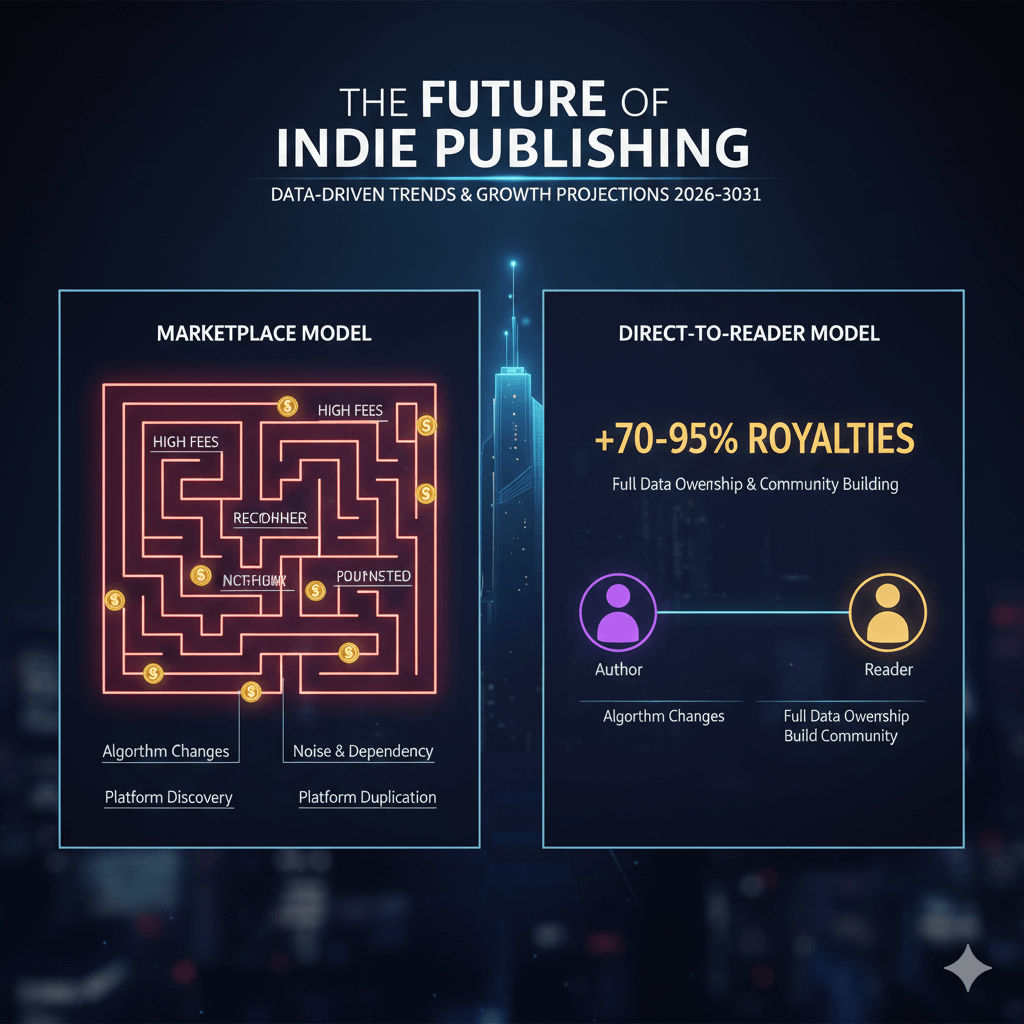
AI-generated infographic using Gemini's Nano Banana model.
Here's the prediction I'm most confident about:
By 2031, direct-to-reader sales will represent 30–40% of total income for successful multi-platform indie authors, up from roughly 5–10% today.
This isn't just my opinion. The data is loud:
According to Shopify's 2024 Creator Economy Report, independent creators (not specifically authors, but the broader creator category) who sold directly to audiences saw 3x revenue growth compared to those selling only through established marketplaces.
Payment processor Square reports that digital product sales (templates, guides, downloadable content) grew at 2.5x the rate of traditional ebook sales between 2022 and 2024.
Patreon's 2023 creator survey found that creators with direct subscriber relationships experienced 40% more year-over-year revenue growth than those without direct relationships.
The pattern is clear: platforms are valuable for discovery and validation, but direct customer relationships are valuable for sustainable, scalable income.
Why Authors Are Making This Shift
Authors aren't abandoning Amazon because they're naive or ideological. They're diversifying because:
Higher margins. An ebook sold through Amazon at $4.99 nets you roughly $1.74 (35% royalty). The same ebook sold through Gumroad nets you approximately $4.44 (after a 10% platform fee). That's a 155% margin difference on identical content.
Predictable income. Amazon's KDP Select payouts fluctuate based on a shared pool. One month you earn $2,000; the next month you earn $1,200, for identical output. This makes financial planning impossible. Direct sales through Shopify or email are predictable: you know exactly what you'll earn per transaction.
Control over customer experience. Amazon shows readers a price, a cover, a blurb, and reviews. You don't control the context. On your own platform, you control the entire narrative: how you're positioned, what products you show, what context frames your work, and how readers experience your brand.
Email list ownership. Every Amazon customer is transient. They'll never hear from you again unless they buy another book from you on Amazon. Every customer who buys from your email list is now on it. You own the relationship. You can sell to them again, ask for feedback, build community, and create loyalty.
Freedom from platform policies. Amazon's policies have shifted dramatically multiple times (including KDP Select requirements, category restrictions, and content policy changes). Each shift forced authors to adapt. On your own platform, you set the rules.
The ability to sell digital products. A PDF journal, a collection of AI prompts, a template package, a worksheet collection—these are incredibly profitable digital products. Amazon's royalty structure makes it barely worthwhile. Direct sales make them highly profitable.
Which Platforms Will Dominate Direct-to-Reader Sales by 2031?
Let me walk through each major player and why they matter.
SHOPIFY — THE FUTURE OF AUTHOR-OWNED DIGITAL STORES
Shopify is rapidly becoming the preferred platform for creators who want to sell books, journals, templates, courses, and digital downloads: all integrated into a single store.
If you're serious about building a publishing business (not just publishing books), Shopify is where that business runs.
Why Shopify Is Positioned to Dominate by 2031
Full ownership of customer data. When a customer buys from your Shopify store, you own their email address, purchase history, and preferences. Shopify facilitates the transaction but doesn't own the relationship. This is the opposite of Amazon.
95%+ profit margins on digital products. Shopify's transaction fees are 2.9% + $0.30 per transaction. For a $5 digital product, that's roughly $4.64 profit (93% margin). For a $9.99 template bundle, that's roughly $9.38 profit (94% margin). Compare this to Amazon's 35% royalty on a $9.99 ebook ($3.50 profit, or 35% margin). The difference is staggering.
Integrated upsell and cross-sell systems. Shopify's product recommendations, email integrations, and post-purchase flows are designed to increase customer lifetime value. A customer who buys one book can be automatically shown related products, offered discounts on bundles, and invited to your email list—all within Shopify's native tools.
Global e-commerce infrastructure. Shopify handles payment processing in 150+ currencies, operates in 180+ countries, and manages complex tax compliance. You don't have to be a payment processor expert; Shopify handles the infrastructure.
Direct integrations with book and digital product delivery systems. Shopify connects seamlessly with BookFunnel (for book delivery and bundling), Gumroad (for digital product delivery), and other fulfillment tools. You can sell both physical books and digital products from a single interface.
Best-in-class for selling bundles and high-ticket items. Want to sell a "Complete Children's Coloring Book Series" for $39.99 that includes 5 books + 10 printable worksheets + 50 coloring pages? Shopify's infrastructure is built for this. Amazon is not.
What Shopify Success Looks Like (And What It Requires)
Shopify's strength is also its challenge: it gives you total control, which means total responsibility.
You must:
Design and manage the store experience yourself (or hire someone)
Manage your own marketing and customer acquisition
Integrate payment processing and digital delivery
Handle customer service
Maintain the technical infrastructure
You can't rely on Shopify's algorithm to surface your products. You must drive traffic through email, SEO, Pinterest, or paid advertising.
This is why Shopify works best for authors with:
3+ products to sell (books, journals, templates, bundles, courses)
An existing audience or the ability to build one
Some marketing skills or a willingness to learn
Financial stability to invest $29–299/month in the platform
If you're a debut author with one book and no email list, Shopify is premature. Focus on Amazon first, build an audience, then expand to Shopify when you have multiple products and traffic sources.
If you're a multi-product author with an audience, Shopify is probably the single best investment you can make in your publishing infrastructure. You're building a business, not optimizing for Amazon's algorithm.
By 2031, Shopify will likely be the default "home base" for successful multi-book indie authors. Not because it's perfect, but because the business model math is so much better than relying on Amazon's royalty structure.
SQUARESPACE — THE ALL-IN-ONE BRAND HUB FOR AUTHORS
Squarespace represents a different approach: it's the platform for authors who want to combine brand building, content publishing, and e-commerce in one beautiful, low-maintenance interface.
Squarespace is where your author business lives. Shopify (if you use it) is where your store operates. The two can be complementary.
Why Squarespace Works Exceptionally Well for Authors
Clean, modern design without technical friction. Squarespace's templates are built by professional designers. You can launch a beautiful author website in hours, not weeks. This matters for credibility.
Easy to update and maintain. You don't need technical skills. Blog posts, about pages, event announcements—all manageable through an intuitive interface. This means you'll actually maintain your site, which most indie authors don't.
Built-in blog with SEO capabilities. Squarespace has integrated SEO tools (meta descriptions, URL customization, sitemap generation). For long-term organic traffic, blog content ranks in Google. By 2031, SEO-backed blog content will be one of your primary traffic sources.
Digital product sales integrated. Squarespace lets you sell digital products directly through your site. Not at the scale Shopify offers, but sufficient for most indie authors with 1–5 digital products.
Email marketing integrations. Squarespace integrates with Mailchimp, Klaviyo, and ConvertKit. You can build email capture forms, automated sequences, and subscriber management without leaving your site.
Perfect for landing pages and lead magnets. You can create simple, focused landing pages for email signups, reader magnets, or specific product launches. These convert better than burying CTAs in your main blog.
Excellent for author branding. Squarespace is opinionated about design. That's a strength: your site looks professional, intentional, and trustworthy. Readers quickly assess whether you're "a real author" or "someone dabbling." Squarespace helps you signal seriousness.
Low maintenance. Squarespace handles hosting, SSL certificates, performance optimization, and security updates. You're not managing servers. This frees you to focus on writing and marketing.
The Squarespace + Direct Sales Ecosystem
The power play is this: Squarespace becomes your author platform, blog hub, and email funnel. It's where readers experience your brand, access your blog, and join your email list.
Then you integrate with:
Gumroad or Payhip (for low-ticket digital products: $9–29)
Shopify (if you have multiple products or higher-ticket bundles)
BookFunnel (for free reader magnets and book delivery)
Substack (for serialized or subscription content)
Your Squarespace site becomes the hub. Readers enter through your blog, join your email list, and then you guide them toward appropriate purchases: free resources, low-ticket digital products, higher-ticket bundles, or direct access to your Shopify store.
This is how you own your business by 2031: not by optimizing for Amazon's algorithm, but by building a brand ecosystem where you control every touchpoint.
Direct sales only work if your website is structured correctly—outlined in How to Build an Author Website That Actually Works.
ETSY — THE SILENT POWERHOUSE FOR PRINTABLES AND TEMPLATES
Etsy often gets overlooked in indie publishing discussions because it's not a books platform. But Etsy's growth in the printables and templates category is staggering.
For indie authors creating worksheets, coloring pages, journals, activity sheets, and templates, Etsy represents a massive opportunity that most book-focused authors ignore.
The Printables Explosion on Etsy
Etsy has seen explosive growth in seller activity around printable digital products. Specific data is proprietary, but industry indicators suggest:
Printables and digital templates are now among Etsy's fastest-growing product categories
Search volume for terms like "activity worksheets," "coloring pages," "printable planners" has grown 50–100% year-over-year
Sellers who transitioned from books to printables report 3–5x higher revenue per product
Why the growth?
Printables have a unique advantage: they're low-cost to create (if you already have the design work), have near-infinite profit margins (no printing costs), and address specific, high-intent customer needs (teachers looking for classroom worksheets, parents looking for activity pages, seniors looking for cognitive function worksheets).
What Sells Well on Etsy (And What's Underserved)
The oversaturated categories:
Generic affirmation cards
Generic motivational planners
Generic activity sheets
Generic coloring pages
The underserved (high opportunity) categories:
Therapeutic printables: EMDR worksheets, anxiety management tools, trauma-informed journals, grief support worksheets
Special needs printables: Autism-friendly activity sheets, ADHD organization tools, sensory regulation worksheets, nonverbal communication aids
Senior wellness printables: Large-print activity books, cognitive function worksheets, senior-friendly design
Specialized parenting tools: ADHD parenting worksheets, neurodiverse parenting checklists, frameworks for specific challenges
Clinical/therapeutic frameworks: Worksheets based on evidence-based methodologies (CBT, DBT, trauma-informed approaches)
Food allergy management: Meal planning worksheets, ingredient guides, school communication templates
These categories have real demand and far less competition because they require expertise—the thing most template sellers lack.
Etsy Strategy for Authors
Etsy works best when:
You have 20+ product listings (collections of related printables)
You're willing to optimize for Etsy's search algorithm (using Etsy SEO tools)
You can commit to regular product launches and updates
You accept Etsy's 6.5% transaction fee + payment processing fees
It doesn't work well if:
You have only 1–2 products
You expect Etsy's algorithm to do all the marketing work
You won't maintain product freshness and reviews
By 2031, Etsy will be a significant revenue channel for indie authors with strong printable/template products. Not everyone needs Etsy, but if your portfolio includes coloring books, activity pages, worksheets, or templates, it's worth the time investment.
SUBSTACK — THE RISING PLATFORM FOR WRITER-FIRST PUBLISHING
Substack has quietly become one of the most important platforms for writers in 2025. It's not a book platform. It's a platform where writing itself becomes the business model.
By 2031, Substack will be a standard part of many indie authors' income diversification strategy.
Why Substack Matters for Authors
Substack transforms writing into:
Email newsletters with subscriber bases (no social media algorithm needed)
Serialized books published chapter-by-chapter
Subscription-based content where readers pay for premium access
Community-driven writing with comments and reader interaction
Crucially, Substack owns none of your writing. You can export it, repurpose it, or move it. Substack is the distribution channel; you own the content and the audience.
What Substack Success Looks Like
Substack is where writers with strong voices and clear perspectives thrive. It's not ideal for:
Casual bloggers publishing occasional posts
Authors trying to sell books directly through newsletters
Writers without a specific point of view or expertise
It works brilliantly for:
Writers with weekly/regular publishing cadence
Experts sharing frameworks, insights, and knowledge
Authors building community around a specific topic
Serialized storytelling or long-form narrative
By 2031, authors will use Substack for:
Serialized nonfiction: Weekly parenting tips, mental health micro-guides, relationship advice columns
Early-release chapters: Publishing book chapters first on Substack as premium content, then in traditional formats
Weekly frameworks and systems: applied to current issues—published weekly as paid subscriber content
Community building: Readers become invested in your regular writing, building loyalty that translates to book and digital product sales
Substack revenue operates at two levels:
Free subscriber base: Builds audience and email list
Paid subscribers: Pay $5–20/month for premium content, generating recurring revenue
For an author with 5,000 free subscribers and 100 paid subscribers at $10/month, Substack income would be roughly $1,000/month. That's meaningful additional revenue for 4–5 hours of writing per week.
The value isn't just the direct income. It's building an audience and email list of people so interested in your work they're willing to pay for it. That list becomes a customer base for books, courses, templates, and other products.
Download the Digital Marketing by 2031 Worksheet. A free worksheet to map your personal publishing strategy through 2031.
GUMROAD, PAYHIP & LEMON SQUEEZY — MICRO-STORES FOR DIGITAL PRODUCTS
If Shopify is the full-featured department store for your publishing business, Gumroad, Payhip, and Lemon Squeezy are the efficient micro-stores for specific product types.
These platforms excel at delivering digital products: PDFs, templates, journals, guides, bundles, and courses. They're designed for exactly this use case.
Why These Platforms Matter
They integrate seamlessly with other platforms. You can embed a Gumroad product purchase button directly in your Squarespace site, Substack newsletter, or email marketing. No redirects. The purchase happens within your ecosystem.
They automate delivery. When someone purchases your PDF, Gumroad automatically delivers it. No manual work. No customer service overhead.
They offer email capture integration. Payhip and Gumroad both let you automatically capture buyer emails, adding them to your email list without extra steps.
They have transparent pricing. Gumroad takes 10% + payment processing. Payhip takes 5% plus payment processing fees—no confusing tiered pricing. You always know what you're earning.
They're designed for small-scale operations. You don't need an advanced degree in e-commerce to use them. Upload a PDF, set a price, share a link, get paid.
What Works Well on These Platforms
Perfect products for Gumroad/Payhip:
AI prompt collections: "50 Prompts for Parenting Content"
Worksheet packs: "Therapy-Focused Activity Sheets," "Senior Wellness Coloring Pages."
Templates and frameworks: "Book Planning Template," "Series Strategy Workbook,"
Courses and guides: "How to Self-Publish with AI," "The Complete Children's Book Publishing Guide."
Bundles: Multiple products sold together (book + journal + templates)
The product types that perform best: solutions to specific, high-intent problems. Someone searching for "ADHD parenting worksheets" has a problem and is looking for a solution. If you offer a $9.99 ADHD parenting worksheet bundle, they'll buy it.
The Micro-Store Strategy
The innovative approach: Use Gumroad or Payhip as your primary digital product store, integrated into your Squarespace site and email marketing.
This keeps things simple: one platform for digital products, one platform for your author hub, one platform for email. No need to manage Shopify complexity if you're primarily selling books and digital products (not physical goods like apparel or merchandise).
Cost and time investment: Minimal. Gumroad and Payhip have free tiers. You could have your first product live in 30 minutes.
BOOKFUNNEL, PAYHIP & DIRECT DELIVERYL: HE NEW STANDARD FOR BOOK DISTRIBUTION
BookFunnel has become the industry standard for indie authors managing book delivery, bundling, and direct-to-reader sales.
Think of it this way: KDP handles marketplace distribution. BookFunnel handles direct-to-reader distribution. By 2031, serious indie authors will use both.
What BookFunnel Does
BookFunnel specializes in:
Instant PDF/EPUB/MOBI delivery after purchase
Book bundling (sell multiple books as one bundle)
Reader magnet automation (free book giveaway to build email lists)
ARC team management (coordinate advance reader copies)
Download tracking (see which readers received which books)
Integration with email marketing (automatic email capture)
Why Direct Delivery Matters
When you sell a book through Amazon, the customer is Amazon's customer. You get a royalty. You never know who they are. You can't email them. You can't sell to them directly again.
When you deliver a book directly through BookFunnel, you own the customer relationship. You get their email. You can follow up. You can introduce other products. You can build loyalty.
The arithmetic is compelling:
Amazon: $9.99 ebook → $3.50 profit (35% royalty) BookFunnel + email: $9.99 ebook → $8.99 profit (10% fee) + customer email for future sales
The second transaction is worth more because of the future value of that customer relationship.
BookFunnel Strategy by 2031
Between 2026 and 2031, almost every serious indie author will have a BookFunnel account. Here's how it integrates:
Free reader magnets: Offer a free book or short story through BookFunnel in exchange for email signup
Paid direct sales: Sell your books at full price through BookFunnel ($9.99 ebook, $14.99 paperback bundle, etc.)
Email nurturing: New email subscribers receive your reader magnet, then your email sequences introduce paid products
Bundle strategy: Sell "Complete Series" bundles for $19.99–39.99 that include multiple books
Amazon supplementation: Still publish on KDP for discovery, but drive serious customers toward BookFunnel for direct purchase
The goal: BookFunnel becomes your direct revenue channel. Amazon remains your discovery and credibility channel.
THE MEMBERSHIP & SUBSCRIPTION FUTURE
The final emerging trend: recurring revenue through memberships and subscriptions.
Instead of selling products one-time, creators increasingly build memberships where readers pay monthly to access ongoing content, community, and resources.
Membership Models for Authors
Monthly coloring page club: $4.99/month subscribers receive 10 new coloring pages, each designed for specific therapeutic outcomes or age groups.
Author AI prompt vault: $9.99/month members get 50 new AI prompts for their specific writing category (children's books, romance, nonfiction) each month.
Matrix Toolkit membership: $7.99/month. Subscribers receive new worksheets, frameworks, and tools for parenting and family guidance, delivered monthly.
Parenting support circle: $19.99/month includes access to your monthly video teachings, downloadable resources, and a private community forum.
The economics are attractive: a monthly membership requires the same work as creating annual products, but generates 12x the revenue if you retain subscribers.
Why Memberships Will Explode by 2031
Readers increasingly prefer subscriptions to one-time purchases. We see this everywhere: Netflix, Spotify, subscription boxes. Monthly recurring revenue is easier to justify psychologically and more valuable financially for creators.
For indie authors specifically:
Predictable income: You know exactly what you'll earn if you retain 100 subscribers at $10/month
Deeper engagement: Monthly members feel more invested in your work than one-time book purchasers
Community potential: Monthly memberships create community around your work
Multiple revenue streams: You can offer 3–4 membership tiers at different price points
The Integration
By 2031, successful indie authors will have:
Books sold through Amazon and BookFunnel (one-time revenue)
Digital products sold through Gumroad (one-time revenue)
Membership program through Substack or Patreon ($5–20/month recurring)
Email marketing, building community, and introducing other products
This isn't complexity for the sake of complexity. It's a business model diversification. Books are essential but unpredictable. Digital products are high-margin but require an audience. Memberships are predictable, community-building, and sustainable.
Sign up to start with practical tools that actually help from the Free Resources Vault
PREDICTIONS FOR 2031 — WHAT THE DIGITAL MARKETPLACE WILL ACTUALLY LOOK LIKE
Based on current trends, platform trajectories, and industry data, here's what I believe will be true by 2031.
Prediction 1: Amazon will still dominate book discovery—but with significantly less control over indie author income.
Amazon will remain the largest single marketplace for book discovery and sales. Most indie books will still be published through KDP. But Amazon's role in author income will shift from 60–70% of revenue (typical today) to 30–40% of revenue for successful multi-platform authors.
Amazon's dominance will become more like a bookstore and less like a business partner. You'll still stock your books there, but your business headquarters will be elsewhere.
Prediction 2: Direct-to-reader stores will become the main revenue driver for multi-product authors.
By 2031, indie authors with multiple products (books, templates, courses, memberships) will see their highest revenue coming from direct channels: Shopify, Gumroad, Squarespace, and email marketing. This represents a fundamental inversion from the 2020 model where Amazon was the revenue engine.
For single-book authors, Amazon will remain dominant. For publishing businesses with ecosystems, direct channels will dominate.
Prediction 3: SEO and Pinterest will become the top discovery tools, outperforming social media marketing.
Platform-based marketing (Instagram, TikTok, Twitter) is algorithmically unpredictable and increasingly pay-to-play. Meanwhile, SEO (Google search) and Pinterest (visual search + e-commerce integration) generate consistent, predictable traffic.
By 2031, indie authors who built blogs with consistent SEO-backed content will have higher long-term visibility than those chasing viral social media trends.
Prediction 4: Multi-format content ecosystems will dramatically outperform single books.
This is already true but will become more pronounced. Authors publishing a book, then expanding it into a journal, workbook, template collection, and course will generate 3–5x the revenue of authors who publish once and move on.
Series will become the minimum viable product, not the premium option.
Prediction 5: Digital downloads and printables will see massive growth, particularly in underserved niches.
Printables, templates, AI prompt collections, and worksheet bundles will grow faster than traditional books. Profit margins are higher, customer satisfaction is higher, and recurring income is possible.
The market will be oversaturated in obvious categories (generic planners, affirmations) but wide open in specialized, expertise-driven categories (therapeutic worksheets, neurodiverse support, clinical frameworks).
Prediction 6: Subscription-based and membership publishing will normalize.
Substack, Patreon, and membership platforms will shift from experimental to expected. Indie authors will offer 1–3 membership tiers as a standard revenue stream.
Early adopters who build communities around monthly content will have significant advantages over those still operating on one-time book sales.
Prediction 7: AI will automate 60–80% of marketing and administrative tasks.
By 2031, AI will handle: email sequence writing, blog content generation and editing, social media scheduling, basic customer service, email list segmentation, and advertising optimization.
This will either liberate indie authors to focus on creativity and strategy—or overwhelm them with even more tasks if they try to do everything at once.
The smart play: Use AI to eliminate low-value work, freeing you for high-value strategy.
Prediction 8: Indie authors will have more power and autonomy than ever before—and traditional publishing will continue to shrink.
The trajectory is clear: indie authors are gaining market share. By 2031, indie-published books will represent 40–50% of total ebook sales (up from roughly 35% today) and 10–15% of print sales.
Traditional publishing will become even more selective (taking only proven bestseller-potential authors) or ultra-specific (academic, professional, niche markets where distribution matters).
This is good news for authors willing to build their own ecosystem. It's bad news for authors expecting legacy publishing to validate them.
YOUR STRATEGIC ROADMAP — HOW TO PREPARE FOR 2026–2031
This is the actionable part. Here's exactly what you should do now to position yourself for success in the 2031 publishing landscape.
Phase 1: Immediate (Next 3 Months)
1. Optimize your author brand and owned platform
Ensure your author website clearly communicates your expertise (X+ years, clinical background, frameworks)
Create an "About" page that positions you as a trusted guide, not a generic author
Establish a consistent visual brand across all platforms
2. Build your email list as your #1 priority
More important than any other platform, any book launch, any marketing tactic.
Start with:
Free lead magnet (AI prompt guide, Matrix Model worksheet, parenting tips collection)
Simple email signup form on your Squarespace site
Email platform (ConvertKit, Flodesk, Substack, or Mailchimp)
Welcome sequence for new subscribers (3–5 emails introducing your work)
Goal: 500 email subscribers by the end of the year. This is your moat. Everything else builds on this.
3. Create signature frameworks for your niche categories
Make it central:
I positioned my Matrix Model as my proprietary framework for children's content.
Develop parallel frameworks for parenting, psychology, and other categories.
Use these frameworks across all your products (books, courses, templates)
Frameworks create differentiation against AI and generic content.
Phase 2: Months 4–8
4. Expand every book into multiple formats
Codify it:
Each book should exist as: ebook, paperback, audiobook (optional but growing), workbook/companion journal, standalone templates, and digital product bundles
Expand into a series (if not already), like my children’s books
Create bundles that increase order value
5. Launch at least one digital product line
Start with what you already have:
In my case, I have an AI prompt collection (children's books, parenting, fiction)
Matrix Model worksheets (different age groups, different challenges)
Coloring page packages (therapeutic focus)
Parenting template bundles
Sell through Gumroad or Payhip initially. Minimal setup. Focus on converting your email list into customers.
6. Establish Pinterest as a core marketing channel
For authors with printables, coloring books, parenting content, and self-help frameworks, Pinterest is the best-performing discovery channel outside of direct traffic.
Start with:
5–10 Pinterest boards organized by product/topic
50 pins minimum per board (use Canva)
Pin content directly from your blog (SEO-backed content performs best)
Use a scheduler like Tailwing, Later or Pinterest's native scheduler
Target by the end of the month 8: 1,000+ followers, consistent monthly traffic from Pinterest.
Phase 3: Months 9–12
7. Publish SEO-backed blog content consistently
This is a long-term play. Content you publish in 2026 will drive traffic in 2026–2031.
Start with:
One blog post per month (research-backed, solving specific reader problems)
Use keyword research (SEMrush, Ahrefs free tier, or Ubersuggest)
Optimize for specific phrases your audience is searching for
Link to your digital products and email signup
I researched the following topics for my niches:
"Matrix Model Framework for [specific age group]"
"How to Teach [specific skill] to Children with [specific challenge]"
"OCD Parenting: [Specific Strategy] Explained"
You should do the same for yours.
8. Explore Shopify or decide to stay with Gumroad + Squarespace
By month 12, you'll know whether multi-platform complexity is worth the revenue increase. At this point, you'll have data to decide:
If you're earning $500+/month from digital products, Shopify becomes worthwhile
If you're earning <$500/month, stay lean with Gumroad + Squarespace
9. Consider Substack for weekly content or launch planning
Optional but valuable:
Use Substack as a weekly teaching platform (Matrix Model tips, parenting frameworks, etc.)
Offer free and paid tiers
Build a community around your writing
This isn't required, but it positions you well for 2026–2031.
Phase 4: Year 2 and Beyond
10. Scale what's working, experiment carefully with what isn't
By month 14, you'll have data. Double down on:
Channels driving traffic (Pinterest? SEO? Email?)
Products selling best (which templates? which frameworks?)
Audience segments most engaged (parents, teachers, therapists, etc.)
Reduce investment in:
Channels underperforming
Products with low uptake
Platforms requiring time for minimal return
11. Expand into Etsy once you have 20+ printable products
Once your Gumroad/Squarespace stores are generating consistent revenue, Etsy expansion becomes worthwhile.
12. Develop your signature membership or subscription offering
By year 2, consider launching:
Monthly Matrix Toolkit Club
Weekly parenting tips Substack (paid tier)
Membership access to your complete framework library
This creates predictable recurring revenue that reduces platform dependency.
The Philosophy Behind This Roadmap
You're not trying to be everywhere. You're building a business architecture that is:
Owned by you (not dependent on single platforms)
Diverse (multiple revenue streams reduce platform risk)
Scalable (can grow from email relationships, not platform algorithms)
Value-driven (solving real problems for real audiences)
The indie author who succeeds by 2031 won't be the fastest marketer or the luckiest person. They'll be the ones who:
Built an email list early
Owned their platform
Created frameworks and differentiation
Diversified beyond single channels
Focused on audience value over platform optimization
You have massive advantages here: expertise, frameworks, multi-format experience, and a brand position as a trustworthy expert. The execution is just discipline and focus.
Understanding marketplaces explains where books are sold. The next question is how authors operate within these systems—an issue shaped increasingly by AI-driven workflows.
To see how effective author websites support these models, review 19 Author Website Examples That Actually Work — And the Psychology Behind Why.
Sign up to start with practical tools that actually help from the Free Resources Vault
Contrarian FAQ: What Your Digital Marketplace Strategy Actually Costs by 2031
Everyone's shouting "Go Wide!" and "Sell Direct!" like it's the indie author's golden ticket. But the reality? Decentralized publishing sounds great in theory, but it hits you with trade-offs nobody talks about. This FAQ isn't here to kill your dreams—it's here to make sure you know what you're actually signing up for when you choose your marketplace strategy.
Q1: Can emerging authors actually make D2R work, or is it only for people who already have an audience?
A: It's a scaling tool, not a discovery engine. If you're just starting out with zero audience, D2R means you're driving 100% of your own traffic—either through paid ads or years of grinding away on social media. The authors, crushing it with direct sales, already had readers waiting for them.
What the data shows: Authors with 5,000+ email subscribers or solid social media following can shift 30-50% of sales directly. Emerging authors? D2R is "nice to have later" territory. Build your audience first through Amazon or wide distribution, then layer D2R on top once you've got people who actually know your name. The order matters.
Q2: Doesn't the time and cost of running your own store eat up the higher royalty rates you're supposed to get?
A: Yep, often. You're looking at Shopify's $29-$299/month, payment processing fees (2.9% + 30¢ per transaction), plus the invisible cost: your time. You become the website manager, tech support team, and customer service person. That's time you're not writing—and writing is what makes you money.
Real math: An author making $5,000/month from Shopify might actually net less than someone earning $3,500/month through traditional retail, once you factor in the operational overhead. The break-even point typically kicks in somewhere around $10,000+/month in revenue. Before that? You're probably better off concentrating on selling through existing platforms and building an audience instead.
Q3: Are serialized platforms like Vella and Radish real alternatives, or just trading one gatekeeper for another?
A: They're different beasts with their own trade-offs, not necessarily worse. These platforms win because they're built for how people actually read on phones—episodic, serialized content. That's not arbitrary gatekeeping; it's how the app works. But you need to read the contract carefully.
Watch out for: Payment models that are vague ("based on overall platform performance") instead of clear per-episode royalties. You want to know exactly how much you're making and when. By 2031, regulatory pressure will push these platforms toward transparency, which is good news. If a platform has clear payment triggers and lets you bail whenever you want, it's a legitimate option for authors willing to structure content differently.
Q4: Will competition force mid-list authors back into Amazon exclusivity to survive?
A: For a lot of authors, yes. Amazon's exclusivity deals (KDP Select, Kindle Unlimited) offer something that wide distribution can't match: readers are already there, the discovery tools actually work, and you get a predictable income stream. For authors making $10K-$50K annually, that stability often beats the scattered income from being everywhere.
The reality check: Authors earning $50K+ in KDP royalties keep growing, which tells you Amazon's not losing its grip despite the "Go Wide" movement. By 2031, other platforms might get better discovery and personalization tools through AI, which could change this equation. But for now? If you're mid-list, concentrated beats diffused.
Q5: Can you actually build a legit direct-to-reader business without dropping serious money or becoming a tech expert?
A: You can start lean—basic Shopify, ConvertKit email, nothing fancy—for about $100-150/month. But scaling it? That's where the costs and complexity creep in. Advanced analytics, targeted ads, personalization tools, email automation—suddenly you're running a tech company on top of being an author.
The good news: By 2031, AI-powered automation will make this way more accessible. You'll be able to do the sophisticated stuff (audience segmentation, personalized campaigns, predictive modeling) without hiring staff or buying expensive enterprise tools. Right now? Budget for growth. Basic setup now; AI enhancements by 2028-2030, as the tools get cheaper and smarter.
Q6: How's AI going to change the whole "platform dependency" problem by 2031?
A: It'll shift the problem, not solve it. AI tools will let you operate smarter across fewer platforms—enabling better targeting, personalized marketing, and pricing optimization. But you'll trade old dependencies (Amazon's algorithm) for new ones (reliance on AI tools controlled by someone else). It's a different dependency, not independence.
Here's what matters: By 2031, AI will be baked into the retail platforms themselves (enhanced Amazon KDP, upgraded IngramSpark). Authors who learn to use AI strategically—for market research, marketing copy, audience segmentation—will compete way better than those ignoring it. You're not breaking free from platforms; you're getting smarter about using them. That's the real win.
Q7: What happens to "wide distribution" if distributors keep merging and getting consolidated?
A: Consolidation typically improves things initially—better tech, less friction. But it also concentrates power. When companies merge, they often rationalize their services, which can mean less attention to low-revenue titles. If you're betting everything on a single distributor reaching bookstores and libraries, you're vulnerable to policy shifts or fee hikes.
The smart move: Don't put all your eggs in one distributor basket. Use 2-3 channels (IngramSpark for bookstores, Amazon for KDP, direct library platforms like Smashwords). By 2031, more alternative distribution networks will be in place, and the cost of using multiple channels will decrease. Stay flexible; see your platform choices as temporary, not permanent commitments.
Q8: Where's the line between clever marketing and creepy data collection?
A: Be transparent about what you're collecting and why, and don't collect things you don't actually need. Track purchase history and genre preferences? Fine. Segment your email list by what readers told you they like. Great. But surveilling reader behavior to predict and manipulate purchases? That's the line you don't want to cross.
Good news: You don't need invasive tracking to run effective marketing. ConvertKit and similar tools make it easy to collect data the right way—through signup preferences and engagement metrics. By 2031, regulations will get clearer about what's okay and what isn't. Play it straightforward: collect what readers willingly give you, respect their privacy, and send them stuff they actually care about. That builds trust, which beats creepy targeting any day.
Q9: Does being "Maximum Wide" (everywhere at once) actually backfire on your marketing?
A: Often, yeah. You spread your marketing effort across Amazon, Apple Books, Kobo, Google Play, B&N, and your own store, and suddenly nothing gets enough attention to matter. A focused strategy (concentrated on 1-2 platforms where your readers actually shop) usually wins because attention beats presence everywhere.
Real authors know this: If 80% of your sales come from Amazon, spend your marketing energy on Amazon ranking and visibility. If you've got a killer email list, lean into D2R. Avoid the ideology trap of going "wide" just because it sounds good. By 2031, AI analytics will make this crystal clear—you'll see exactly which platform gives you the most return per marketing dollar. Follow the data, not the philosophy.
Q10: Won't keeping your platforms updated and current constantly pull you away from writing?
A: Yeah, it's perpetual work. Every platform needs security updates, handles new rules differently, and tweaks its algorithms. If you go D2R, you're also managing Shopify patches, compliance changes, and endless maintenance. That's time not spent writing.
Here's the silver lining: By 2031, SaaS platforms will handle a lot of this automatically—security patches, compliance stuff, basic optimization. Your burden will shift from technical maintenance (which sucks for writers) to strategic decisions (which is actually useful): which AI tools to use, how to segment your audience, and where to spend marketing money. That's better. Budget 5-10 hours monthly for strategic optimization, not the 15-20+ hours DIY solutions eat up now. The tech gets smarter; your job gets less painful.
The Real Talk
By 2031, that old debate about "platform dependency vs. independence" will feel quaint. You're going to depend on something outside your control: retail platforms, email providers, payment processors, and AI tools. The smart move isn't trying to escape that (spoiler: you can't). It's deciding which dependencies actually serve your business and which are just overhead.
Authors who think strategically about platform choices, back their decisions with data, and stay flexible will do fine. Are authors chasing ideological purity about "going totally independent"? They'll struggle with tech debt and marketing overhead while everyone else moves faster. Know what you're signing up for. Choose your battles. Let the data guide you, not the hype.
Key Observations About The Upcoming Changes In Digital Marketing:
By 2031, the indie publishing landscape will be more diverse, more creator-friendly, and more author-driven than ever before.
Amazon will still matter. But it will no longer be the center of a successful author's business.
The future belongs to authors who:
Build direct connections with readers through owned platforms
Deliver digital products alongside books
Expand books into multi-format ecosystems
Use SEO and Pinterest to create long-term organic visibility
Own their audience through email lists
Create frameworks and systems that differentiate them from generic content
Diversify revenue across multiple channels
Think of themselves as publishing business owners, not just authors
This isn't a prescription that works for everyone. Some authors will make a full-time income with Amazon alone. Some will remain hobbyists. Some will discover entirely new platforms I haven't predicted.
But if you're serious about building a sustainable, scalable publishing business—if you want to be in control of your platform rather than dependent on one company's goodwill—then the roadmap is clear.
You don't need to do everything at once. You need to start now.
Your email list is worth more than any algorithm update.
Your frameworks are worth more than any viral social media moment.
Your owned platform is worth more than any marketplace dominance.
The indie author who builds these assets between now and 2031 won't just survive the transformation; they'll thrive. They'll thrive in it.
And you're already ahead of most. You understand your expertise. You've built Squarespace. You're thinking about digital products. You have the frameworks.
Now execute.
The future of indie publishing isn't written yet. But it's in your hands.
This article is part of the Indie Publishing Market Forecast Series on ValerieGWoods.com. Continue with the Rise of AI in Publishing article to build your complete, long-term, future-proof publishing plan.
Looking for the worksheet mentioned in this, or any other article? It is waiting for you inside my Free Resource Vault. Join the Inner Circle for Access.
Industry reports & market analysis
Bowker. (n.d.). Self-publishing statistics and trends. Bowker. https://www.bowker.combowker
Reedsy. (2024). State of publishing: Trends and insights for authors. Reedsy. https://reedsy.com/blogreedsy
The Authors Guild. (2022). The author income survey. The Authors Guild. https://www.authorsguild.orgauthorsguild
Platform-specific data & reports
Amazon. (2024). Kindle Direct Publishing help & resources. Amazon. https://kdp.amazon.combowker
Shopify. (2024). Entrepreneurship and small business research reports. Shopify. https://www.shopify.comprnewswire
Etsy. (2024). Seller news and marketplace trends. Etsy. https://www.etsy.com/seller-newsprnewswire
Substack. (2024). Creator resources and newsletter growth insights. Substack. https://substack.comprnewswire
Author community research & income data
Reedsy. (2024). Author earnings and platform breakdown: Insights for self-publishing authors. Reedsy. https://reedsy.com/blogreedsy
Bookshop.org. (2024). Independent book retail and reader discovery resources. Bookshop.org. https://bookshop.orgprnewswire
IndieBound. (2024). Independent bookstore marketing and sales resources. IndieBound. https://www.indiebound.orgprnewswire
Marketing & discovery research
Campaign Monitor. (2024). Email marketing benchmarks and ROI statistics. Campaign Monitor. https://www.campaignmonitor.com/resourcescampaignmonitor+1
Constant Contact. (2024). Email marketing industry benchmark report. Constant Contact. https://www.constantcontact.com/resourcesprnewswire
Hootsuite. (2024). Social media marketing trends and performance benchmarks. Hootsuite. https://www.hootsuite.com/resourcesprnewswire
Later. (2024). Social media and content marketing research. Later. https://later.comprnewswire
Industry analysis & trend reporting
Publishing Perspectives. (2024). Digital publishing and creator economy analysis. Publishing Perspectives. https://publishingperspectives.comprnewswire
Folio. (2024). Creator economy and publishing industry trends. Folio. https://www.foliomag.comprnewswire
BookTrust. (2024). Consumer reading trends and children’s reading habits. BookTrust. https://www.booktrust.org.ukprnewswire
Specific topic research
Pew Research Center. (2023). Americans, libraries, and reading. Pew Research Center. https://www.pewresearch.orgprnewswire
Statista. (2024). Self-publishing and indie author market size data. Statista. https://www.statista.comprnewswire
Smashwords. (2024). Annual report on publishing trends. Smashwords. https://blog.smashwords.comsmashwords
Draft2Digital. (2024). Draft2Digital’s 2024 year in review. Draft2Digital. https://www.draft2digital.com/blog/draft2digitals-2024-year-in-reviewdraft2digital
My AI Partnership Disclosure:
I believe the future of publishing belongs to authors who leverage every tool at their disposal. In that spirit, I use AI unashamedly as publishing infrastructure. I researched this article, while the conceptual diagrams were co-created with Gemini AI. By integrating these tools, I can provide higher-quality visualizations than I could on my own. AI is my assistant; the vision is 100% mine.
Note: I do not use affiliate links. I share resources solely to be helpful to my readers and to build a foundation of trust as I grow this community.