The Author Website System FAQ Schema Templates
Your Author Website Is Invisible to Google. These FAQ Schema Templates Fix That.
A collection of seven ready-to-use JSON-LD code templates extracted from The Author Website System: A Strategic Framework for Visibility and Email Growth — designed for authors who want their website pages to appear in Google's expandable FAQ rich results, without hiring a developer or learning to code from scratch.
The strategy exists. The templates are ready. The only thing left is to work through them.
Why the Digital Version Works Better
Type directly into the workbook (no printing required)
Save your progress and come back anytime
Reuse pages for multiple projects
Designed for clarity, structure, and real implementation
SAMPLE PAGES
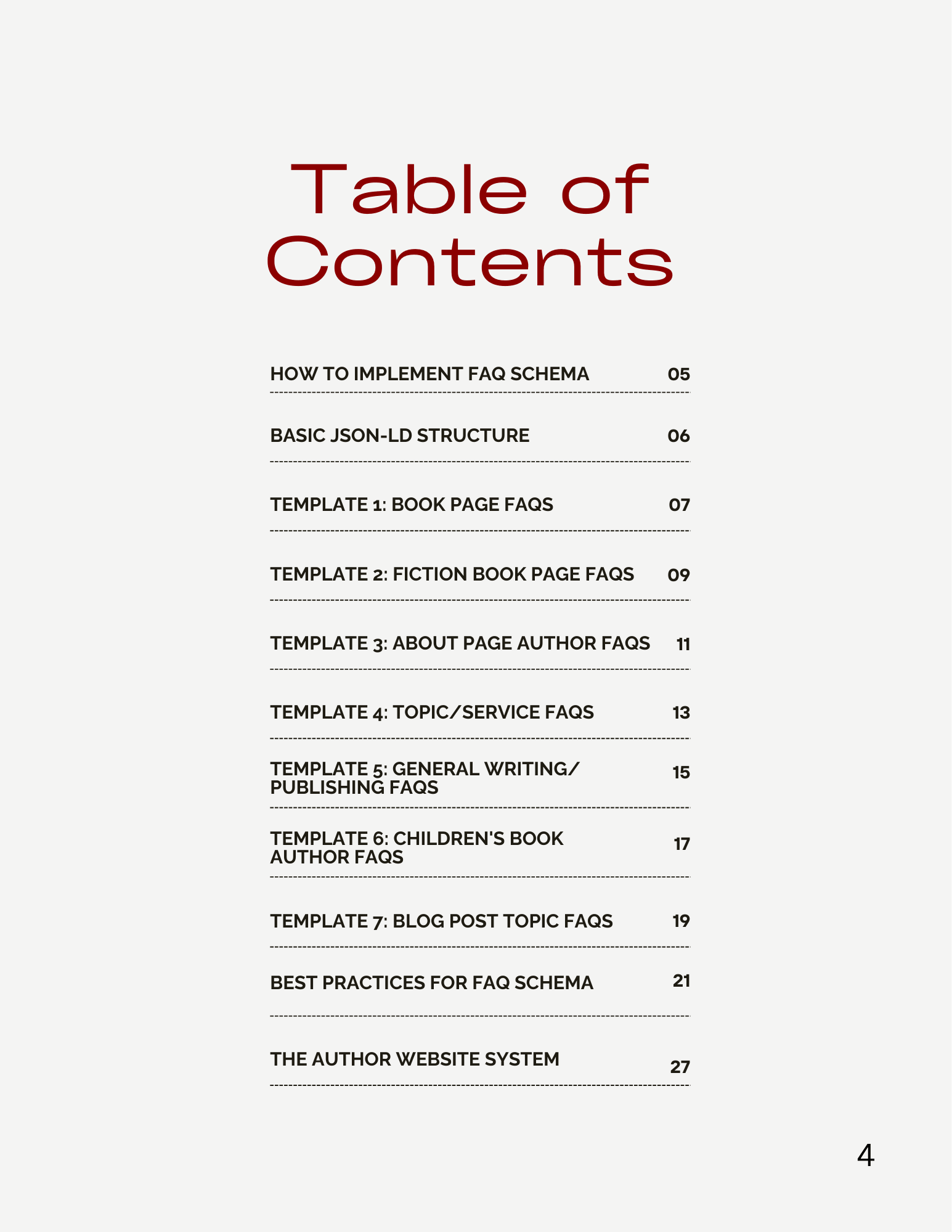
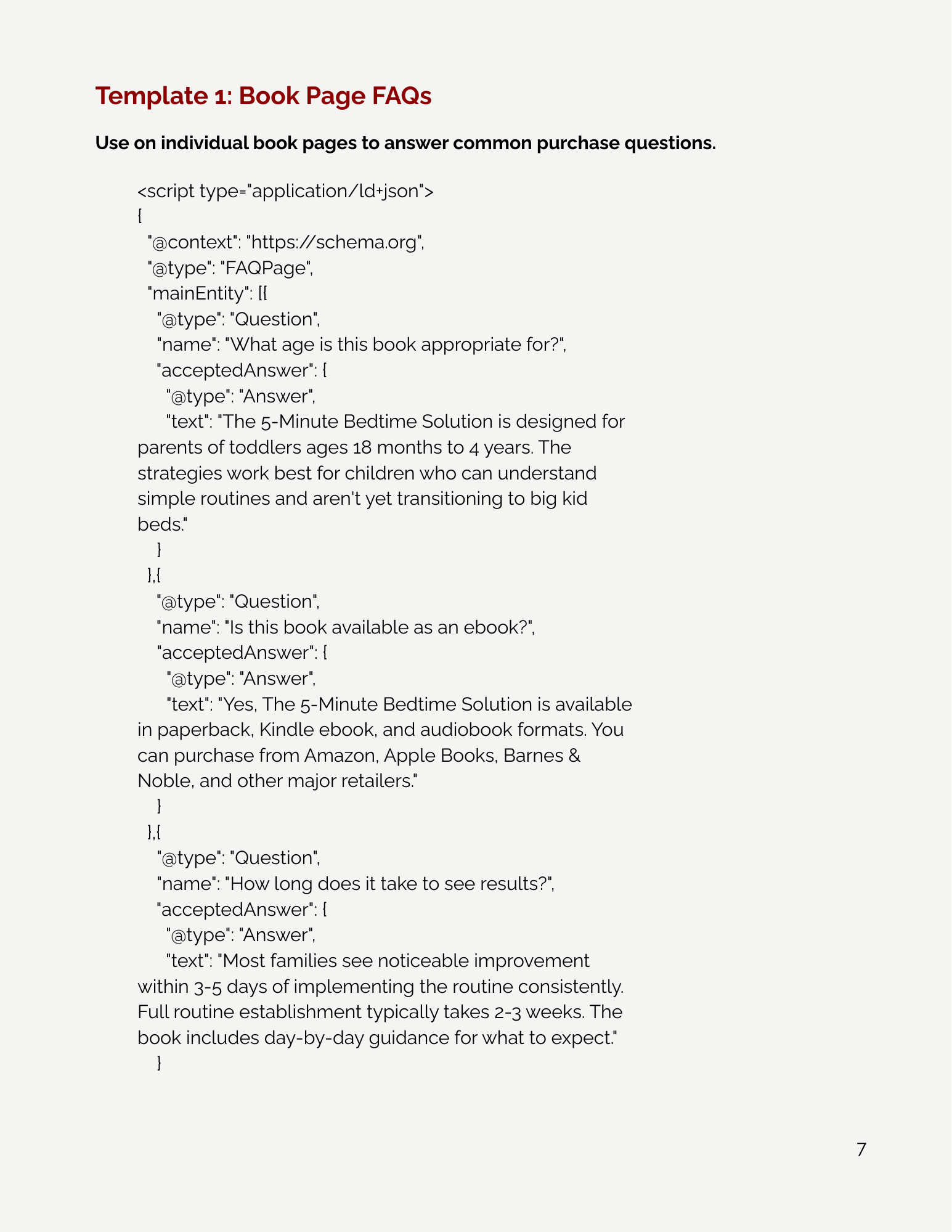
Get extra visibility from Google. The schema code can increase both how often your pages appear in search engines and how many people click through to them.
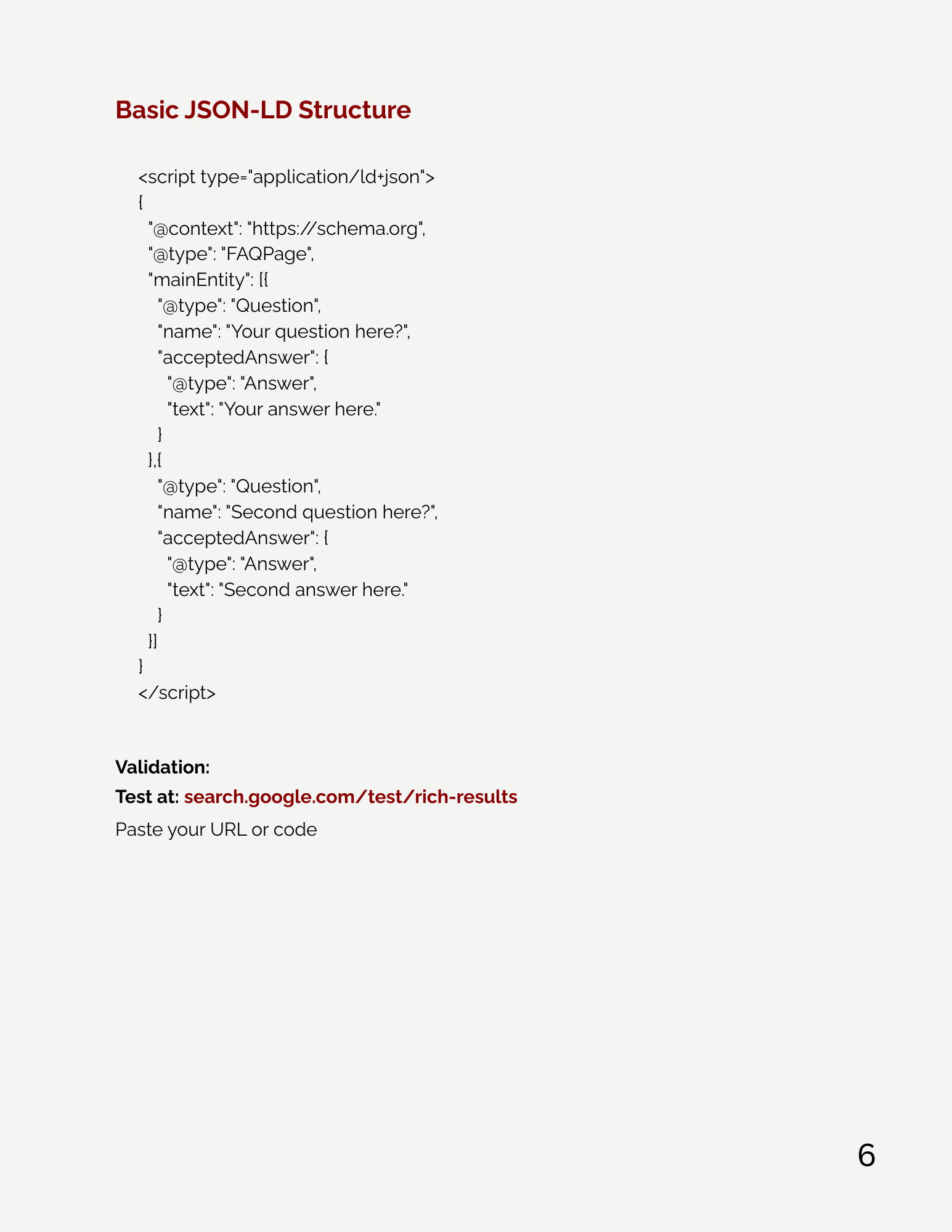
Know the format of the basic JASON-LD (for your FAQ Schema) structure. Check your code in Google prior to uploading your FAQ Schema code to your website.
THE PROBLEM
You've written the books. You've built the website. You've added the pages, the bio, the purchase links.
And yet, when someone searches for your name, your book title, or the topic you write about, your website barely shows up. Or if it does, it's just a plain blue link buried halfway down the page.
Here's something most authors don't know: Google gives extra visibility to pages that use structured data: specifically, expandable question-and-answer boxes that appear directly in search results, above most of the other links. This is called FAQ schema, and it can increase both how often your pages appear and how many people click through to them.
The catch? Implementing it requires writing code in a specific format, and most authors have no idea where to start.
These templates solve that problem entirely.
WHAT'S INSIDE THE FAQ TEMPLATES
Seven ready-to-use FAQ schema templates, one for every core page type on your author website:
Template 1: Book Page FAQs (Nonfiction) Answer the questions readers actually ask before buying — age ranges, formats, whether extra materials are needed, what results to expect. Copy the code, swap in your book's details, and add it to your page.
Template 2: Fiction Book Page FAQs Cover the questions fiction readers want answered — series order, genre, content warnings, page count, special editions, reading time. Includes prompts to customize for your specific novel.
Template 3: About Page Author FAQs Help readers, media, and event organizers find answers about you — your book count, your background and credentials, your speaking availability, and how to reach you. Strengthens your authority in search results.
Template 4: Topic/Service FAQs For authors who offer consultations, workshops, or expertise-based services. Includes questions about what's included, pricing, who you work with, and what happens if the approach doesn't work.
Template 5: General Writing/Publishing FAQs For authors who field questions about their process, their publishing path, or advice for aspiring writers. Answers common questions while directing readers to your blog or deeper resources.
Template 6: Children's Book Author FAQs Specifically designed for children's book authors answering questions from parents and educators — age appropriateness, school and library availability, author visits, discussion guides, and themes addressed.
Template 7: Blog Post Topic FAQs For comprehensive blog posts that answer multiple related questions on a topic. Helps Google identify and surface your content as an authoritative resource in your subject area.
Also included: A clear explanation of how FAQ schema works, step-by-step implementation instructions for WordPress, Squarespace, Wix, and self-built sites, best practices for content quality and technical formatting, a common errors and fixes reference table, and a page-type summary showing which template to use where.
WHY THIS MATTERS
Most author websites are invisible to Google, not because the content isn't there, but because Google doesn't know how to categorize it.
FAQ schema is structured data that tells Google: "This page has questions and answers. Here's exactly what they say." When Google recognizes this, it may display your page with expandable Q&A boxes directly in search results, taking up significantly more space, above standard links, and giving searchers a reason to click through to your site before they look at anything else.
It works especially well for the types of questions readers search when they're deciding whether to buy a book, book a speaker, or reach out to an author. Questions like "Is this book part of a series?" or "What age is this book for?" or "Does [author] offer school visits?" Answered directly in search results, pointing straight to your page.
The templates here are written specifically for the questions authors' readers actually ask. You don't need to figure out the right questions. You don't need to learn JSON-LD syntax from scratch. You copy the template, fill in your details, add it to your page in four steps, and validate it with Google's free tool.
WHO THIS IS TEMPLATE FOR
This resource is for you if:
You have an author website but haven't implemented any structured data or schema markup
You've heard of FAQ schema but didn't know it applied to author websites — or how to do it
You want your book pages, About page, or blog posts to have a better chance of appearing in expanded Google results
You write nonfiction, fiction, children's books, or a combination — there's a template for each
You're not a developer and don't want to build code from scratch, but you're willing to copy, customize, and paste
This resource is also for authors who are actively building or refining their website and want to add the technical layer that most authors skip — the one that tells Google exactly what kind of content is on each page.
HOW TO USE THE FAQ TEMPLATES
Select the template that matches your page type
Customize the questions and answers with your specific information
Add the code to your website using the platform-specific instructions provided
Validate using Google's Rich Results Test (link and instructions included)
The templates can be used immediately and independently — no other purchase required. The included best practices section tells you exactly what to do and what to avoid so your implementation has the best chance of being recognized by Google.
One important note the resource is honest about: FAQ schema doesn't guarantee your page will show rich results, Google makes that determination. But implementing it correctly gives your pages the opportunity to be considered, which is something most author websites don't have at all.
Need more resouces to build your website? Check out the Author Digital Toolikit for additional useful resources.
This workbook/template is part of a book: Author Website System:A Strategic Framework for Visibility and Email Growth designed to help you move from confusion to a clear, structured, working website. Paperback: 449 pages. Available on Amazon.com The CompanionWorkbook is also availablein paperback 78 pages on Amazon.com.